Cherry Hill Roofing brings more than 20 years in the trade to roofing in Woolwich, and here the job often begins with a question that has nothing to do with shingles: whose rules apply to this roof? A great many homes in the township sit inside a homeowners association, and an owner thinking about solar has to know where the association’s say begins and ends.
We start every leak call in the attic as well as on the roof, so the water is traced to the spot where it actually enters before we price anything. We also tell you plainly whether the roof can be repaired before replacement comes up at all, which matters on a house that may still have years left in its current shingles.
When a roof does need replacing, our written scope breaks out tear-off, decking, underlayment, flashing, ventilation and gutters on separate lines. That lets you set our estimate beside anyone else’s and compare item by item, and it gives an association’s paperwork, if your community asks for any, a clear description of the work.
Woolwich’s Association Neighborhoods
A Township Built in Two Decades
Woolwich grew faster than almost anywhere in New Jersey. Its population went from 3,032 in 2000 to 10,200 in 2010, and apart from tiny Teterboro it was the state’s fastest-growing municipality of that decade. The 2020 census counted 12,577 residents, the township’s highest count ever. Housing followed the same curve, and it shaped who governs much of what sits on a roof here.
Census estimates count 4,401 housing units in Woolwich, and 3,446 of them were built in 2000 or later. Only a few hundred homes predate 1990. That build era is background for us rather than the point: what it produced, more than any particular shingle, is a township organized largely around planned neighborhoods with their own governing documents.
Weatherby and the Villages at Weatherby
Much of that growth landed in the Weatherby development. A township official told a business publication in 2022 that a lot of the homes built over the previous 20 years went up there, and estimated Weatherby at about 4,200 homes once it is built out. That is a projection of the finished development, not a count of houses standing today.
Property listings in the area name a Villages at Weatherby homeowners association, and other subdivisions such as the Courts at Woolwich carry their own names. We have not read any Woolwich association’s declaration or architectural guidelines, so we never tell an owner what their board will approve. What we can explain is the state law that sets the outer limits of what a board may decide about solar.
Detached Homes and Attached Rows
Most Woolwich housing is detached: the census estimates 3,157 detached single-family units against 456 attached ones, with smaller multi-unit buildings making up most of the rest. Among owner-occupied homes, 3,010 are detached and 345 are attached. Those two groups are where the solar statute does its work, and it treats them differently.
The difference matters before any roofing conversation goes far. A detached house that you solely own sits in one category under the law, while an attached townhouse depends on what the community’s documents say about who repairs its roof. We ask which kind of home you own, and how its documents assign the roof, at the first visit.
Looking for roofing closer to Hammonton? See Roofing Services in Hammonton.
What New Jersey Law Lets an Association Decide About Solar
The Roofs the Statute Protects
New Jersey’s statute on solar collectors in associations, N.J.S.A. 45:22A-48.2, says an association shall not adopt or enforce a rule prohibiting their installation on two kinds of roof. The first is the roof of a single-family home that is solely owned and not designated a common element. The second is a townhouse roof that the governing documents make the owner’s responsibility to repair.
That protection reaches only those roofs. A roof the association owns or maintains as common property is not on the list, and the law does not cover every home in a community simply because it belongs to one. We read the statute narrowly, the way it is written, and we suggest owners do the same.
What the Association Keeps a Say In
The same section lets an association regulate three things. It may set the qualifications, certification and insurance required of whoever installs the collectors, it may regulate where on the roof they go, and it may regulate how supporting structures, fixtures and piping are concealed. Other subsections of the law exist, and we do not quote figures from parts we have not read.
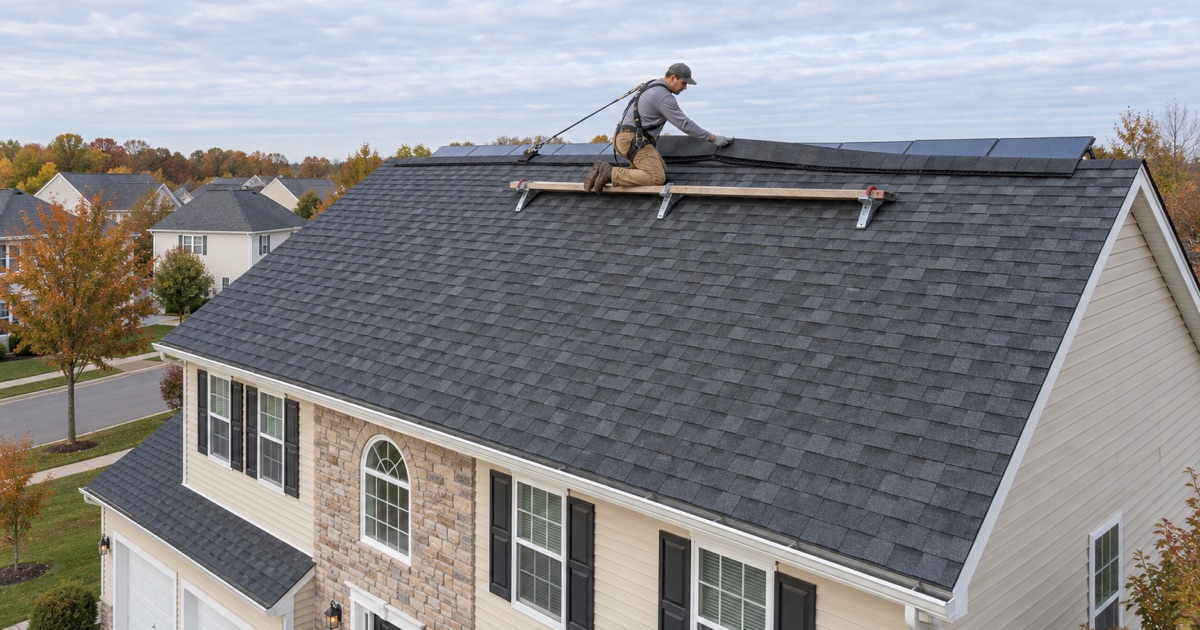
In practice that means a board can shape a solar project without being able to forbid it on a protected roof. Placement and concealment are roofing questions as much as solar ones, because the mounts that hold an array pass through the shingles and underlayment, and every penetration has to be flashed and sealed.
Townhouse Roofs and Who Repairs Them
For an attached home, the deciding text sits in the community’s governing documents. If they make the townhouse roof the owner’s to repair, that roof falls under the statute’s protection. If the association repairs it instead, the statute’s protection does not reach that roof. Repair responsibility is the whole question, so we ask to see the clause before we talk about scheduling.
The same clause is worth reading for what it says about who hires the roofer and who pays for the work. On a townhouse row, roofs share edges with the units beside them, so work on one can affect the flashing and shingle courses of its neighbors. We point that out early, because a board or the adjoining owners may need to know before a crew arrives.
Woolwich’s Own Rules for Solar on a Roof
Solar as an Accessory Use
The township has its own layer. Woolwich’s code, at Section 203-32.1, treats a solar energy system as an accessory use that produces power for the property it sits on. We have read that section through a planning summary rather than in full, so we describe its scope here, not its exact wording.
According to that summary, the section sets standards for color, signage, rooftop and ground-mounted placement, screening and setbacks. An accessory use is one that serves the main use of a lot, which here is the home. For an owner, the practical point is that the township’s standards apply alongside whatever the association has adopted, not instead of it.
Rooftop Versus Ground-Mounted Arrays
The code summary also covers ground-mounted systems. On a residential lot, a ground mount must be screened from public view and is limited to 800 square feet. Some owners compare that option against a rooftop array, particularly when the roof itself is approaching replacement. We do not sell or install either kind, but we can tell you honestly how much life your current roof has left.
That answer shapes the decision. A roof with several good years remaining may simply need its flashing and pipe boots checked before anything is mounted on it, while a worn roof is often better replaced first so the array does not sit on shingles near the end of their life. Either way, you hear it before any replacement price.
Three Sets of Rules on One Roof
Put together, a Woolwich roof with solar on it answers to three sets of rules: the state statute, the township code and the association’s own documents. The statute decides whether an association can say no on a protected roof, the township sets placement and screening standards, and the association may regulate installers, location and concealment.
That framing is ours, built from reading the law and the code summary side by side; no single document lays it out. We use it as a checklist when an owner asks what to sort out before roofing and solar work are scheduled, so nothing in the association’s rules surfaces after the shingles are already chosen.
Roofing Work Inside an Association Neighborhood
Panel Placement and the Roof Beneath
Because an association may regulate where collectors go on a roof, the plane that ends up carrying them is not always the owner’s first choice. Whatever plane it is, the roof under it should be sound, properly ventilated and flashed before an array covers it for years. We inspect that plane from the attic side too, looking for stained sheathing or signs of past leaks.
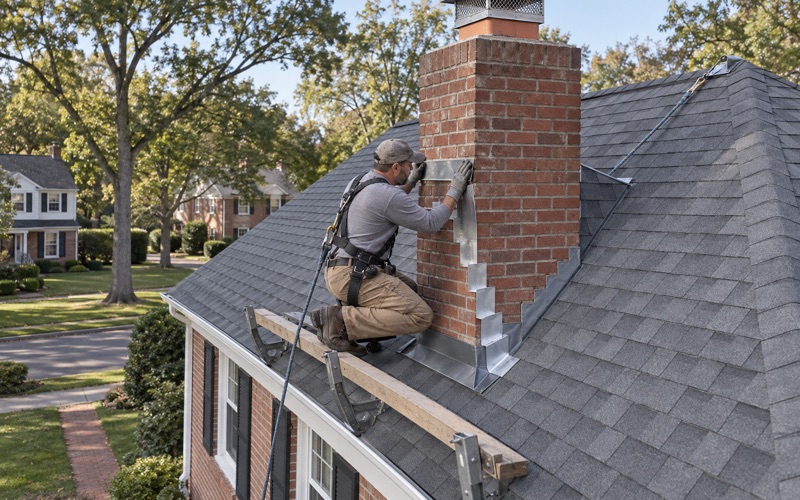
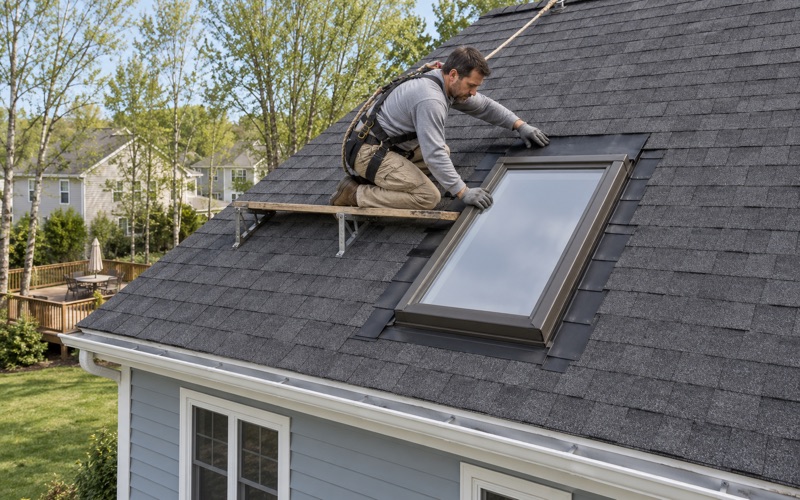
If the old roof comes off, any damaged decking we find is photographed and shown to you before it is replaced, at a per-sheet price fixed in the contract. Flashing at walls, skylights and where two roof planes meet is replaced rather than caulked over, which matters most on a plane that will soon be hard to reach under an array.
Reading the Documents Before the Estimate
Since we do not know what any particular Woolwich association requires, we ask owners to pull their governing documents and any architectural guidelines before we finalize a scope. If a board has a review process for exterior changes, that timeline belongs in the plan alongside material lead times and weather.
Our contracts follow New Jersey’s home improvement rules, including the cancellation notice. Where a question is really for the board or the township, we say so instead of guessing, because a wrong answer about association rules costs an owner more than a short wait for the right one.
Color, Cleanup and the Street
Shingle color gets chosen against the actual house, with samples held up beside the brick, stone or siding on site. In a planned neighborhood where homes along a street were built in the same years, how a new roof sits next to its neighbors is a fair question, and if your association has published color guidance, we work from it.
At the end of every work day the yard, driveway and gutters are cleaned and the ground is swept with a magnet for nails. On streets where houses sit close together and neighbors share sightlines, a clean site each evening is part of doing the job properly. Storm damage, when it happens, is photographed and written up for your own insurance claim, and we will meet the adjuster on site if you ask.
- 20+ Years on Local Roofs
- Repair-First Advice
- Itemized Written Scopes