
Cherry Hill Roofing provides skylight installation in Cherry Hill, NJ, serving surrounding cities including Haddonfield, Haddon, Collingswood, Bellmawr and Gloucester City. In more than 20 years as roofers, we have installed new skylights, replaced old ones and fixed a great many that leaked, which has taught us that the skylight itself is rarely the weak point. The flashing around it is.
A skylight is a hole in the roof, and keeping water out of that hole depends on how it is framed, flashed and tied into the surrounding shingles. Many leaks we see come from units sealed in place with caulk or roofing cement instead of a proper flashing kit, or from skylights reused under a new roof without new flashing.
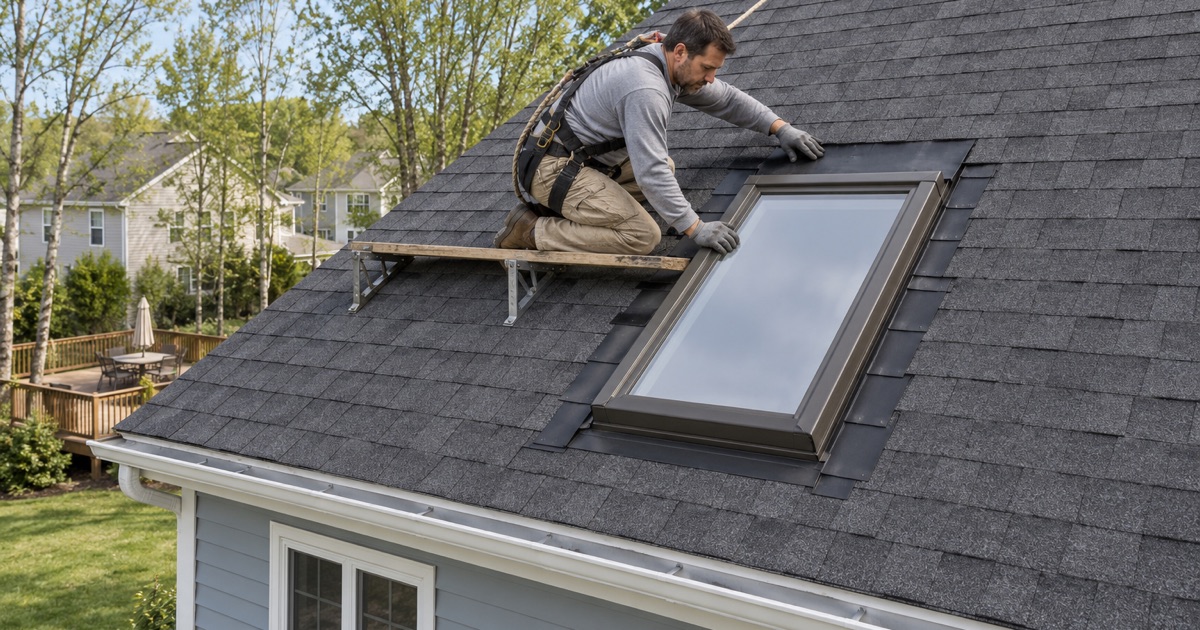
We install skylights as roofers, not as window installers. The opening is framed and flashed in layers, with an ice and water barrier around the curb and step flashing woven into the shingles, so the skylight sheds water the same way the rest of the roof does.
Types of Skylights
Deck-Mounted Skylights
Deck-mounted skylights attach directly to the roof deck and sit low on the roof. They come with flashing kits designed for the unit, which makes them a reliable choice on most new installations in sloped shingle roofs.
Because they sit close to the roof surface, deck-mounted units have a clean, low profile from the street. We install them with the manufacturer’s flashing kit and an ice and water barrier around the opening, following the installation sequence the kit requires.
Curb-Mounted Skylights
Curb-mounted skylights sit on a raised wooden frame built on the roof. The curb lifts the skylight above the roof surface, which suits low-slope roofs and many replacement situations where an older curb is already in place.
The curb itself needs to be sound and properly flashed. When we replace a curb-mounted skylight, we check the curb for rot and either repair it or rebuild it before the new unit goes on.
Fixed, Venting and Tubular Units
Fixed skylights let in light but do not open. Venting skylights open to release heat and moisture, which is useful in bathrooms, kitchens and upper-floor rooms that trap warm air in summer.
Tubular skylights bring daylight through a small reflective tube into hallways, closets and bathrooms where a full skylight will not fit. They need only a small roof opening and are flashed like a large vent pipe.
Installing a New Skylight
Choosing the Location
The location of a skylight affects both the light and the risk of leaks. We look at the rafter layout, the slope and the direction the roof faces, and keep skylights away from valleys and other places where water concentrates.
South- and west-facing skylights bring in the most light but also the most summer heat. We discuss the room’s use and the orientation of the roof so the result is a bright room rather than an overheated one.
Framing the Opening
Cutting a skylight opening often means cutting one or more rafters. The cut rafters are headed off and supported with doubled framing so the roof keeps its strength around the opening.
For rooms with a flat ceiling, a light shaft is framed through the attic from the roof to the ceiling. The shaft is insulated and sealed so the skylight does not become a path for warm, moist air into the attic.
Flashing the Skylight
Flashing is where skylight installations succeed or fail. We wrap the curb or unit frame with an ice and water barrier meeting ASTM D1970, install the manufacturer’s flashing kit, and weave step flashing into the shingle courses along the sides.
At the top, the flashing laps under the shingles above; at the bottom, it laps over the shingles below. Every layer is installed in the order water runs, so nothing relies on caulk to stay dry.
Condensation and Ventilation
Not every wet skylight is a leak. In winter, warm, humid air from showers and cooking condenses on the cold glass and drips onto the sill or the ceiling below, which looks just like a roof leak but has nothing to do with the flashing.
Venting skylights, bath fans that exhaust outdoors, and well-insulated light shafts all reduce condensation. When we inspect a skylight that drips, we check whether the water is coming from outside or inside, so the right problem gets fixed.
Skylight Repair and Replacement
Reflashing a Leaking Skylight
If a skylight leaks but the unit is in good condition, reflashing is often the fix. We remove the surrounding shingles and the old flashing, install new flashing and an ice and water barrier, and weave the shingles back in.
Many leaking skylights we see have been patched repeatedly with roofing cement around the frame. That cement often traps water and hides the real failure, so we remove it rather than add another layer.
Replacing Fogged or Failed Units
When the seal between the glass panes fails, the skylight fogs from the inside and loses much of its insulating value. Cracked glazing, rotted frames and venting units that no longer close properly are also reasons to replace a skylight.
We replace the unit with one sized to the existing opening where possible, which avoids reframing. If you want a different size or type, we adjust the framing as part of the job.
Skylights and a New Roof
The best time to replace an aging skylight is during a roof replacement, when the shingles around it are coming off anyway. Installing a new unit then avoids cutting into new shingles a few years later.
If the skylight is relatively new, we keep it and replace only its flashing during the reroof. Old flashing should never be reused under a new roof, and that applies to skylights as much as to chimneys and walls.
- 20+ Years on Local Roofs
- Repair-First Advice
- Itemized Written Scopes