Cherry Hill Roofing brings more than 20 years in the trade to roofing in Nether Providence, and in this township a good share of the work starts with a question about trees rather than shingles. A roof with heavy limbs above it wears differently, sheds debris into its valleys and gutters, and needs a different plan when the time comes to replace it.
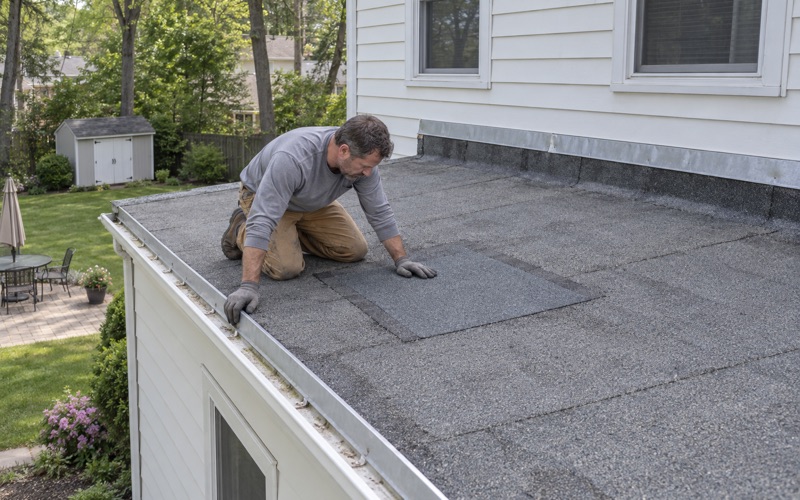
We start every leak call in two places, the attic and the roof surface, so the water is followed to the point where it actually gets in before any price is put on paper. Then we tell you plainly whether the roof can be repaired. Replacement only comes up when a repair would not hold, and when it does, the scope lists each part of the job on its own line.
What follows covers the parts of a roofing job that change in this township: the rules around large trees, who is allowed to cut them, what the April 2025 storm showed, and how the houses here shape the work. Where a step belongs to another trade, we say so, and we plan our schedule around it.
Heritage Trees Over Nether Providence Roofs
What the township calls a Heritage tree
Nether Providence keeps a chapter of its code, chapter 71, for trees, and it singles out the largest ones. A Heritage tree is one with a caliper of 36 inches or more. Removing or disturbing one, pruning more than 20 percent of its branches within a 12-month period, or doing any work inside its tree protection zone requires a township permit.
Those thresholds decide whether a tree job near your house needs township paperwork at all, so the size of the trunk matters before anyone talks about the roof. We have no count of how many Heritage trees stand over houses here, but where one does, its crown becomes part of the roofing plan.
Limbs over the roof before a tear-off
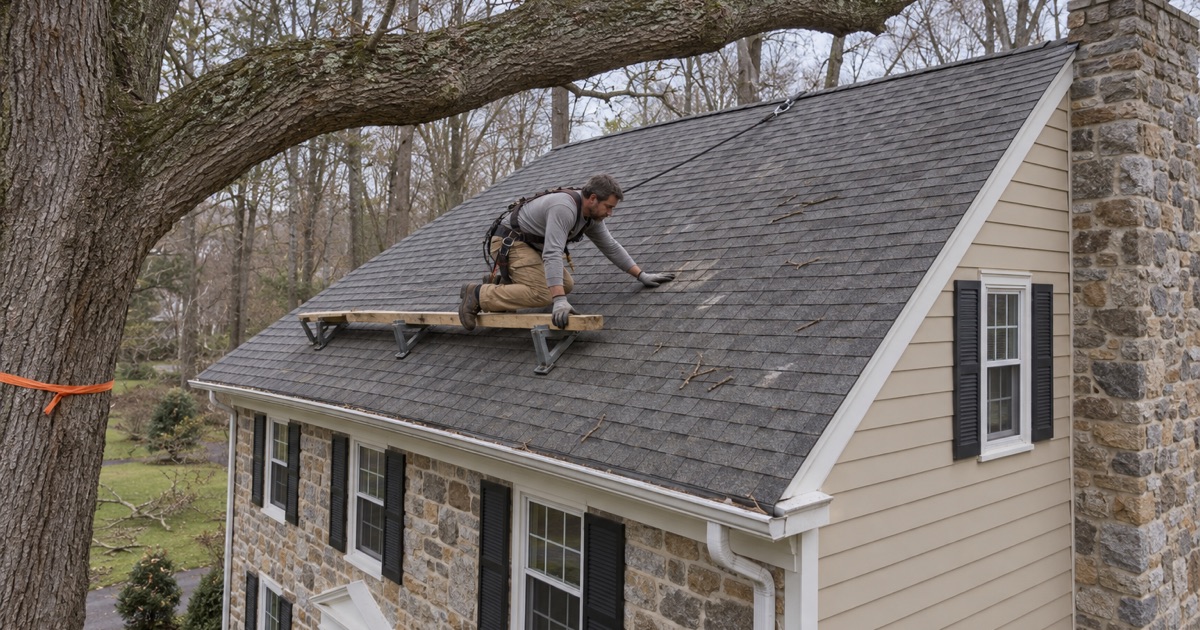
Cutting back branches that hang over a roof is a common step before a re-roof. Overhanging limbs drop leaves and twigs into valleys, hold shade and moisture on the shingles, and get in the way of the crew, the dumpster chute and the new materials. On our reading of its wording, the township’s chapter treats that pruning as tree work, with the same rules as any other cut.
If the tree over your roof is a Heritage tree, heavy pruning or work inside its protection zone can need a permit before anyone climbs it. That matters for timing. We would rather know about the tree at the estimate than learn on tear-off day that the limbs over the back slope cannot be touched yet.
Building the schedule around the tree
When a tree has to be pruned first, we set the roofing dates after that work is done and the debris is cleared, the same way we plan around solar panels that have to come off and go back on. Nothing about the tree is left to be discovered on the morning the crew arrives.
Shade from a large crown also affects how a new roof is set up. Ridge vent with soffit intake keeps air moving through the attic, and drip edge at the eaves and rakes, along with seamless aluminum gutters, helps a roof under trees carry its runoff and leaf litter off the house instead of into the fascia.
Looking for roofing closer to Woolwich? See Roofing in Woolwich.
Who May Cut a Tree in Nether Providence
The township tree contractor license
Under § 71-4 of the township code, anyone paid to do tree work in Nether Providence needs a township contractor license, and the rule covers public and private land alike. The packet names arborists, tree surgeons and landscape companies, and lists felling, pruning, removal and stump grinding as work the license covers.
The same section also sets insurance and workers’ compensation requirements for those contractors. For a homeowner, the practical point is simple: whoever climbs the tree over your roof should be able to show that township license before any saw starts. Asking for it at the start costs nothing and avoids a stop-work conversation halfway through the job.
What the Shade Tree Commission weighs
Heritage tree permits go before the township’s Shade Tree Commission, which works under Ordinance 738 on contractors and Heritage trees. Among the things the commission considers are a tree’s danger of falling and its proximity to existing or proposed structures, which is exactly the situation of a big tree leaning over a house.
The packet says an application not acted on within 30 days is considered approved, and appeals go to the Board of Commissioners. Because that text dates from a packet prepared years ago, we suggest confirming the current process with the township when the tree work is first discussed, well before a roofing date is fixed.
Where our part of the job begins
We are roofers, and we do no tree work of any kind. We do not cut, prune or remove trees, and we do not apply for tree permits. What we do is mark which limbs touch or overhang the roof on our estimate, so you and a township-licensed tree contractor can decide what happens to them.
Once that work is finished, our crew takes over. The written scope then shows tear-off, decking, underlayment, flashing, ventilation and gutters as separate lines, so if a limb has already scraped or punctured part of the roof, you can see exactly what it adds to the price rather than finding it folded into one total.
After the April 2025 Storm in Wallingford
What happened on Colonial Drive
Many residents call the township Wallingford, after its largest community, because the Wallingford postal code covers most of it. Overnight before Friday, April 4, 2025, storms brought down trees and power lines there, and Wallingford schools closed because buses could not get around the damage.
On the 300 block of Colonial Drive, a large tree came down onto a street and a house, and its branches hit neighboring homes. A National Weather Service team determined the cause was straight-line winds. No wind speed was published, and no injuries were reported, but it showed how quickly a tree near a house becomes a roofing problem.
Photographing tree damage for your claim
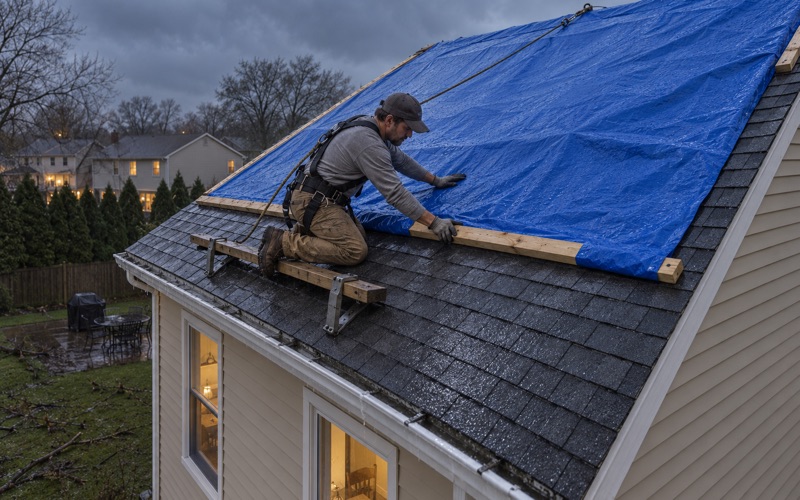
When a limb or a whole tree lands on a roof, we photograph the damage and write it up for your own insurance claim, covering the shingles, decking, flashing and gutters it touched. If you ask, our crew will meet the adjuster at the house so everyone is looking at the same damage.
The tree itself is not ours to move. Clearing a fallen trunk or cutting hung limbs off a roof is paid tree work, so it belongs to a contractor holding the township license. Once the weight is off the roof, we come in to trace any leaks from the attic side and price the permanent repair.
Repair before replacement
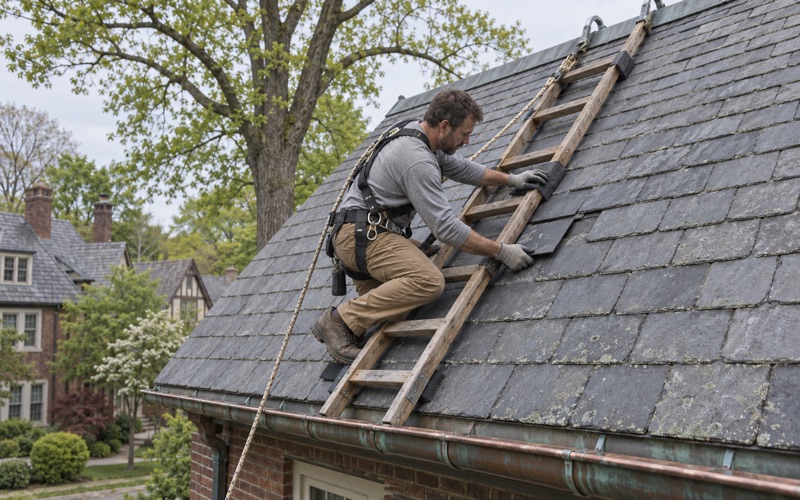
A single tree strike can damage one section of a roof rather than all of it. We look at the decking, rafters and surrounding shingles first, and if the rest of the roof is sound, a repair is the answer we give. Replacement comes up only when the damage, the roof’s age or both make a patch a poor use of money.
When the old covering does come off, any damaged decking is photographed and shown to you before a sheet is replaced, at the per-sheet price already set in the contract. That keeps a storm repair from turning into an open-ended bill. The same photographs go into your claim file if the storm caused it.
Roofing Nether Providence’s Detached Houses
Detached, owner-occupied homes
Of the township’s 5,227 housing units, 3,797, or 72.6 percent, are detached houses, and 4,499 of 5,091 occupied homes are owner-occupied. That is a lot of separate roofs, each with an owner deciding on their own when to prune nearby trees and when to re-roof.
For owners planning to stay, the color of a new roof matters for years, so we choose shingle color with you at the house, holding samples up against the actual brick, stone or siding rather than choosing from a brochure. Architectural shingles such as GAF Timberline HDZ, Owens Corning Duration and CertainTeed Landmark each read differently against the same wall.
Flashing at chimneys, walls and valleys
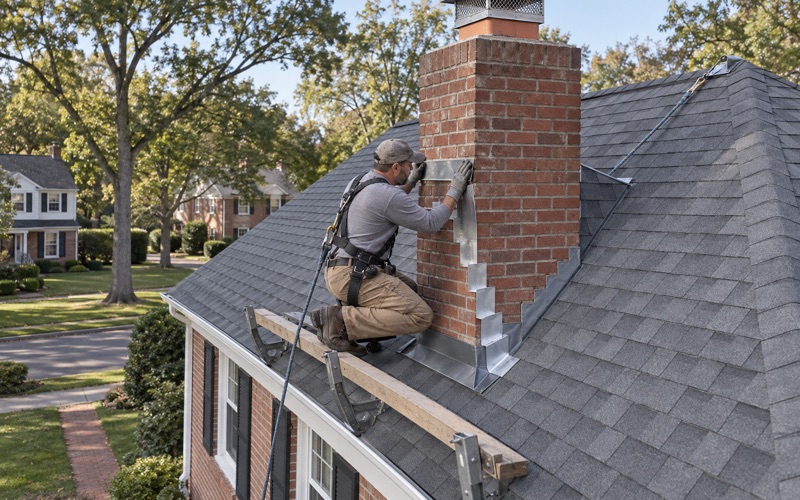
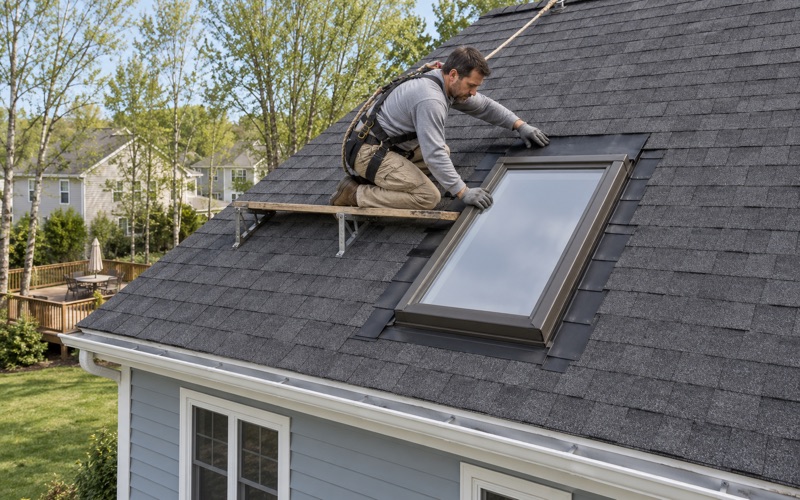
When we redo a roof, the flashing at chimneys, sidewalls, skylights and the places where two roof planes meet is replaced, not sealed over with caulk. Step flashing and counter flashing set into a reglet, along with a chimney cricket where one is needed, are what keep water out at those joints, where caulk alone eventually lets go.
Under the shingles, we use an ASTM D1970 self-adhering ice and water barrier at the eaves and in valleys, with synthetic underlayment rated to ASTM D8257 across the rest of the deck. Valleys collect the needles and leaves that fall from overhanging trees, so they are where a careful underlayment detail earns its keep.
Cleaning up under the trees
A tear-off can scatter old shingles and nails into beds, lawns and driveways, and a big tree overhead adds its own debris to the mix. At the end of every work day, our crew cleans the yard, the driveway and the gutters and runs a magnet sweep for roofing nails, so the property is safe to walk on that evening and not only when the job is finished.
If you are weighing a re-roof against the limbs above your house, start with an inspection from the attic and the roof. We will tell you what the roof needs, which branches are in the way, and what a township-licensed tree contractor would have to handle before our crew sets a ladder.
- 20+ Years on Local Roofs
- Repair-First Advice
- Itemized Written Scopes