Cherry Hill Roofing has spent more than 20 years on roofing in Florence and across South Jersey, and the work here asks for a slower kind of attention than a subdivision reroof. A large portion of the township’s homes share a roof with the house next door, and many of those roofs began life as slate. We start every job by finding out what is actually up there before anyone talks about price.
On a leak call, one of us goes into the attic as well as onto the roof, because water on a ceiling rarely enters directly above the stain. Once we know where it gets in, you get a plain answer on whether the roof can be repaired, and replacement only comes up if repair genuinely will not hold.
Our written scopes break tear-off, decking, underlayment, flashing, ventilation and gutters into separate lines, so a second estimate can be laid beside ours and compared item by item. Contracts follow New Jersey’s home improvement rules, cancellation notice included. The page below covers what changes about that work in Roebling and the rest of the township.
Roebling’s Company-Town Houses
Built Beside the Wire Mill
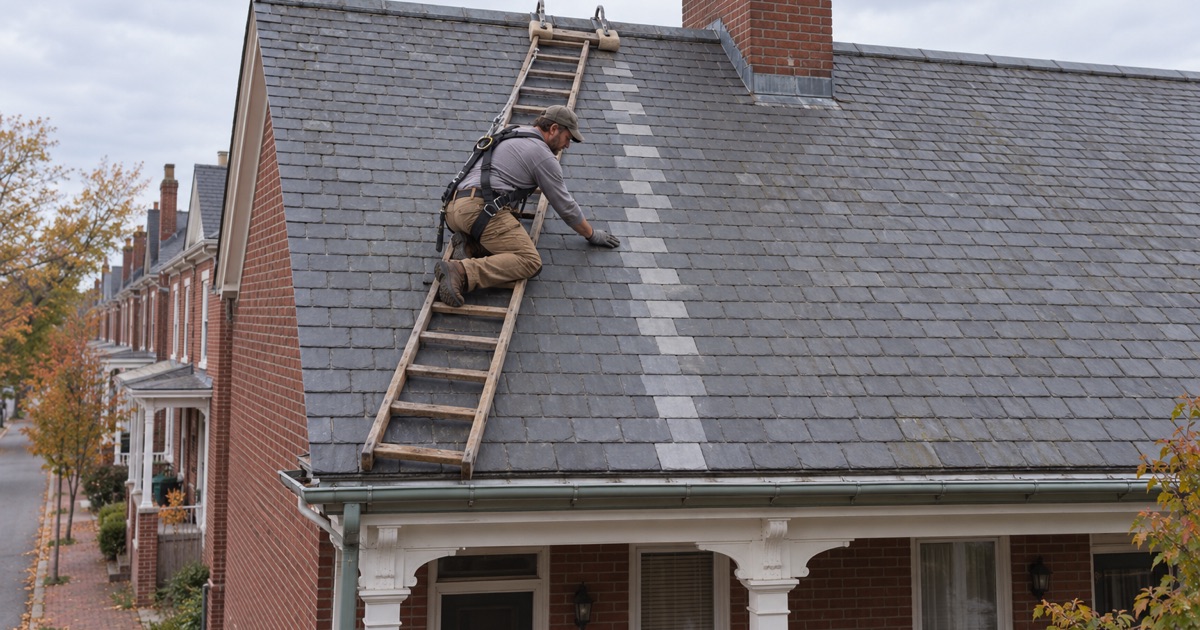
Roebling is a company town in the literal sense. Beginning around 1905, Charles Roebling laid out the village beside the John A. Roebling’s Sons Co. wire mill, and according to the Advisory Council on Historic Preservation he built 750 brick houses on a rectangular grid, in ten different designs, most of them roofed in slate.
The houses were part of how the company ran. Unskilled workers rented row homes, skilled workers rented duplex cottages, and managers lived in the largest houses along Riverside Avenue. The mill was sold to Colorado Fuel and Iron in 1953 and closed in 1974, and many of the workers eventually bought their homes from the company.
What That Stock Means Today
Those houses still shape the township’s housing. The 2024 five-year American Community Survey counts 5,076 homes in Florence Township, and 1,708 of them, about a third, are one-unit attached houses. Separately, 1,569 were built in 1939 or earlier, close to a third of the total. Of the attached houses, 1,398 are lived in by their owners, so the person paying for a roof repair usually sleeps under it.
That mix matters before anyone sets a ladder. A detached 1990s house and a 1905 brick row are different jobs, with different materials, different access and different neighbors to consider, and the estimate has to say which one it is describing. We look at the house first, then write a scope that fits the building actually in front of us.
The Historic District Record
The Roebling Historic District was listed on the National Register of Historic Places on May 22, 1978. It covers 76 acres and 94 contributing buildings, and in January 2011 Roebling was named a Preserve America Community. Neither recognition, on its own, tells an owner what material to put on a roof.
What the record does tell us is that the district’s character comes from repetition: rows of the same few designs, built at the same time, in the same brick, and originally roofed largely in slate. A roof repair that looks wrong on one house is visible from the whole block, which is a good reason to match material whether or not anyone requires it.
Looking for roofing closer to Upper Southampton? See Roofing Services in Upper Southampton.
Slate on Shared Roofs
Rows and Duplex Cottages
On a Roebling row home or duplex cottage, the roof is usually one continuous plane running across more than one owner’s house. Where slate survives, it does not stop at the property line; the courses run straight through it, and the ridge and gutters usually run through as well.
That shared plane is what makes these roofs different from a detached house. A leak on your side may start at a valley or flashing detail on your neighbor’s side, and work on your half can change how water moves across theirs. We sort out which share of the roof is at fault before recommending any work.
How Much Slate Is Left
No record we have found says how many Roebling houses still carry their original slate. Over more than a century, some owners will have kept it, some will have patched it with other materials, and some will have replaced it outright, so the only way to know what is on a given house is to look.
A mixed roof is possible: slate on one half of a twin and asphalt shingle on the other, or slate on the main plane with a later material on a rear addition. We note and photograph exactly what is up there on both sides of the line before we price anything.
Reading an Old Slate Roof
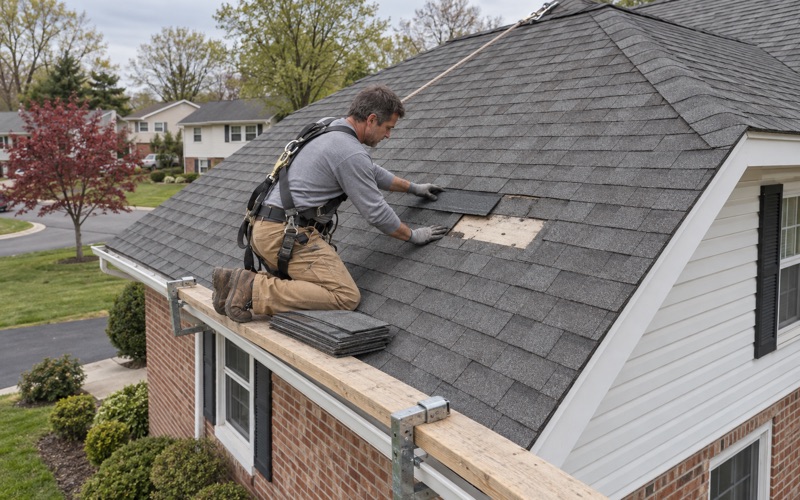
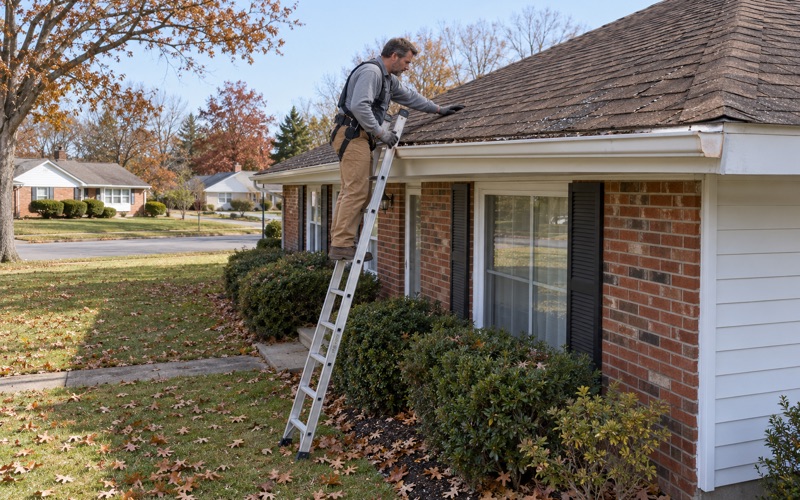
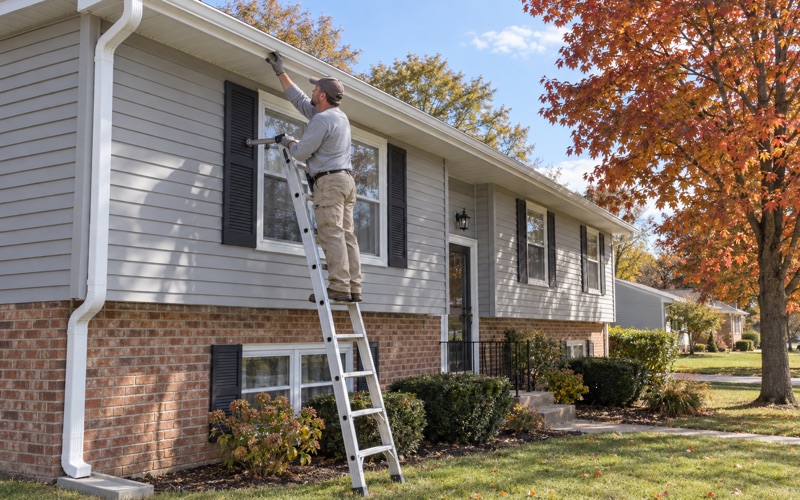
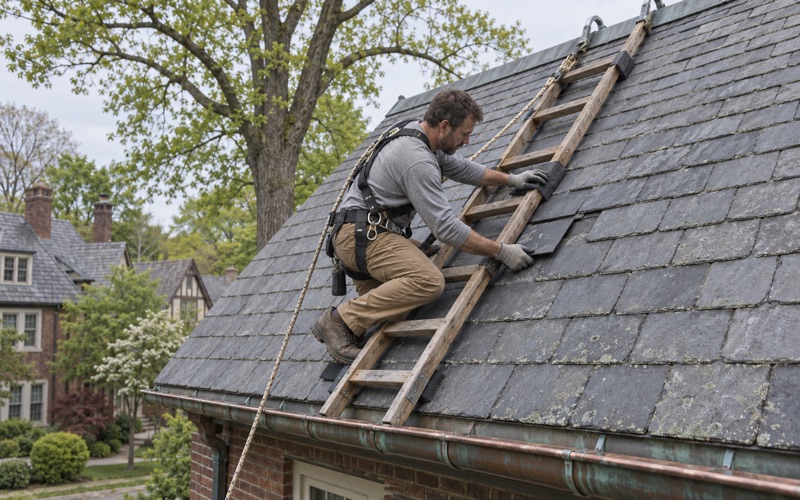
Slate itself can last a very long time; what usually gives out first is everything around it. Rusted nails let pieces slip, flashing at chimneys and walls wears through, and a careless earlier repair can crack sound slate nearby. Walking on slate can break it, so we work from ladders, hooks and roof brackets rather than across the field.
A slate roof with a handful of missing or broken pieces is usually a repair, not a replacement, and we say so plainly. When the problem is widespread nail failure across the whole plane, we explain that too, with photographs, so you can see the condition yourself rather than taking our word for it.
Repairing One Share of a Slate Roof
Stopping Cleanly at the Line
When only your side of a row or twin needs work, the repair has to end where your house ends without leaving a seam that leaks. We weave new slate into the old courses at the line, keep the exposure and headlap consistent with what is already there, and flash any transition so water cannot run under the joint.
The neighbor’s roof stays the neighbor’s. We do not pull their slate to make our work easier, and when a ladder, bracket or staging has to cross onto their side, we ask before it does. Talking to the next owner before the work starts usually saves an argument after it.
Shared Ridges, Valleys and Chimneys
Some details on a joined roof belong to both houses at once: the ridge that runs the length of the row, a valley where a rear wing meets the main roof, or a chimney that sits on or near the line. Patching one owner’s half of a shared detail rarely holds for long.
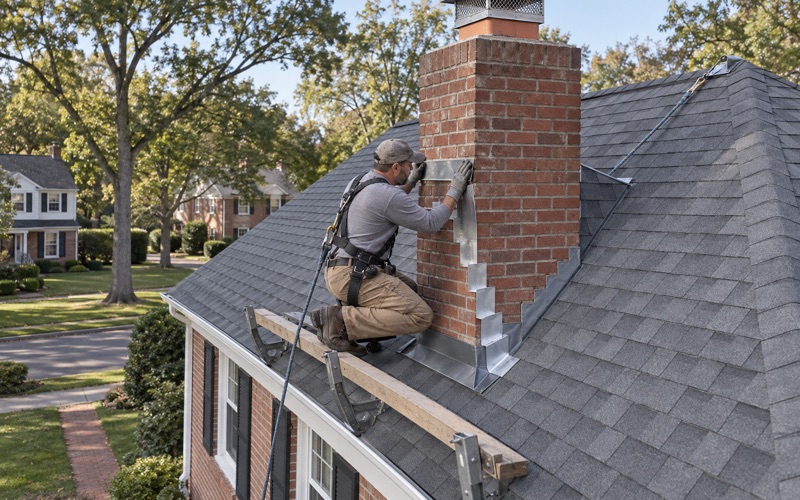
Where a chimney or wall needs flashing, we replace it with new step flashing and counter flashing set into a reglet rather than caulking over the old metal. If the detail genuinely spans both houses, we explain what a lasting fix needs from each side and price your share separately, so you and your neighbor can decide together.
Finding the Leak Before Pricing It
On attached houses, the stain on your ceiling and the hole in the roof can be several feet apart, sometimes on opposite sides of the line. Water runs along rafters and sheathing before it drips, so we go into the attic to follow it back to where it actually enters.
That tracing is what keeps the price honest. A repair priced from the ground, or from the stain alone, can fix the wrong spot or bill you for work on a neighbor’s problem. Once the source is found, the written scope says where it is, what fails there, and what each line item costs.
Matching Slate, Changing Material and Newer Homes
Sourcing Salvaged Slate
Where a Roebling roof is still slate, we repair it with slate that matches in color, size and thickness, sourced from salvage where it can be found, rather than with whatever happens to be on the truck. Matching color matters on a row where the same roof line is read across several houses at once.
Replacement pieces are hung with copper nails or slate hooks so they sit flat and stay put. When a match cannot be sourced, we tell you before the work starts and show you the closest options, rather than surprising you with a mismatched patch after the crew has left.
When Changing Material Makes Sense
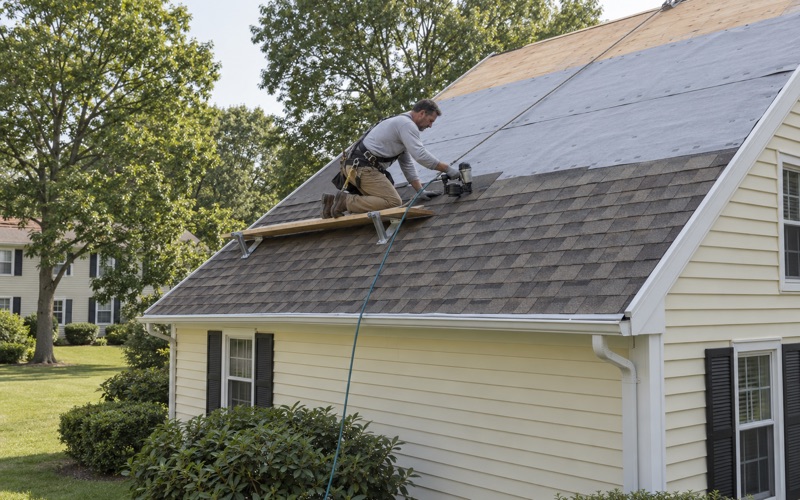
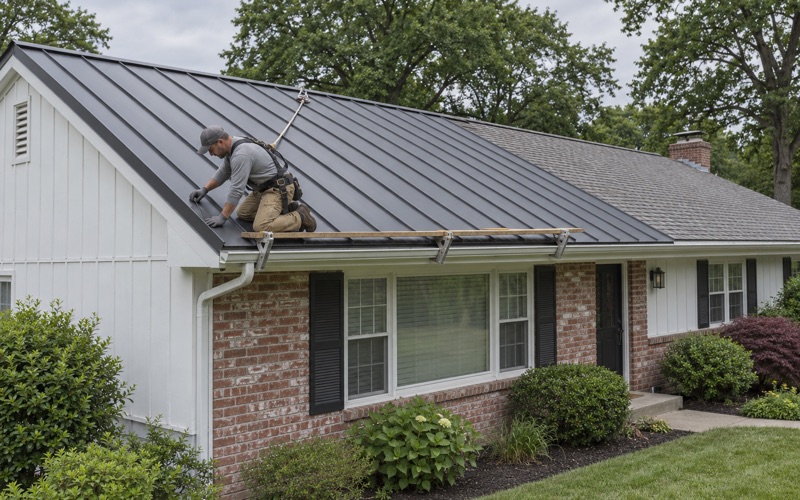
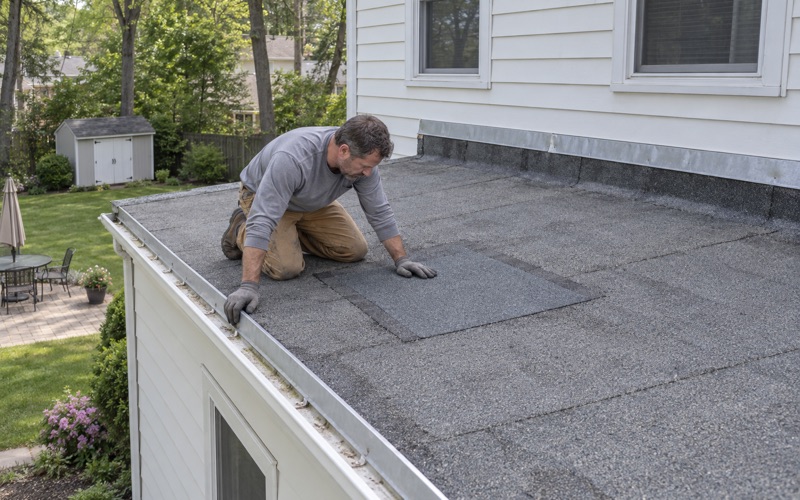
Some owners decide restoring slate is not worth it, especially where their half was reroofed in another material years ago. Changing to architectural shingles or standing seam metal is a legitimate choice, and we will price it as plainly as a slate repair, with tear-off, decking, underlayment and flashing on separate lines.
On an attached house the change has to be planned at the line, where a new material may meet the neighbor’s slate. We detail that joint so it sheds water, choose a color held up against the brick on your actual house, and show you any damaged decking in photographs before it is replaced at the per-sheet price written into the contract.
Florence’s Newer Subdivisions
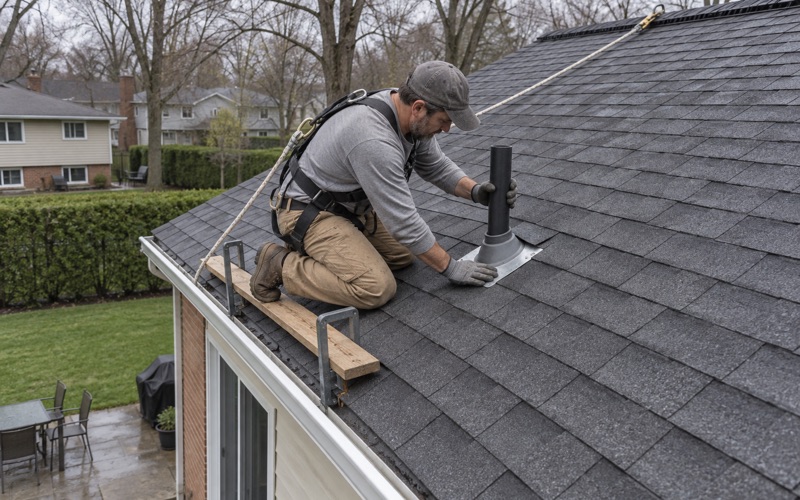
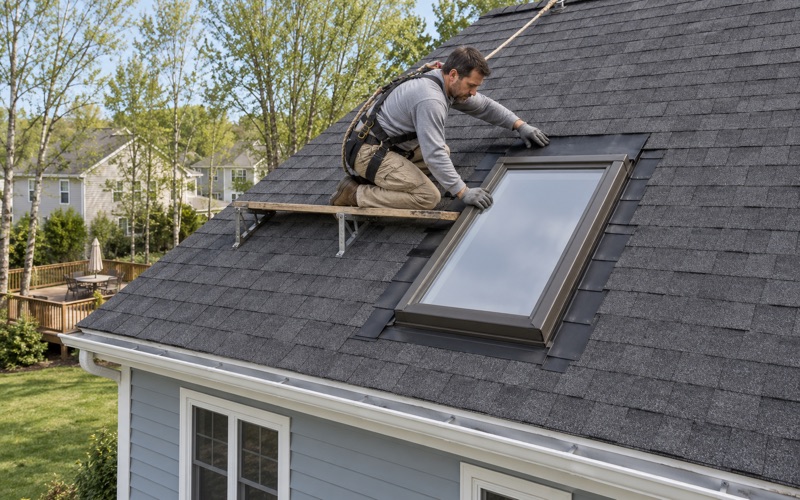
Not all of Florence Township is Roebling. The township also takes in the Florence section and a broad range of later housing: the census counts 2,635 detached homes, and more than 2,500 units built between 1970 and 2019. On a detached house of that age the roof is more often asphalt shingle, and the wear shows up at pipe boots, vents and the drip edge.
Those roofs get the same process as a slate row: a look from the attic, a straight answer on repair versus replacement, and a written scope broken into separate lines. If solar panels are on the roof, removal and reinstall go into the schedule from the start, and the yard and driveway get a magnet sweep for nails at the end of every work day.
- 20+ Years on Local Roofs
- Repair-First Advice
- Itemized Written Scopes