Cherry Hill Roofing brings more than 20 years in the trade to roofing in East Greenwich, and on a lot of roofs here the question that matters is what the wind has done. A house can look fine from the street while a run of shingles along one edge has already lost its grip. Our job is to find that before water does, and to tell you plainly what it will take to fix.
We start every leak call in two places: the attic and the roof surface. Water that shows up on a bedroom ceiling often enters well away from the stain, so we trace it back to where it actually gets in before we put a price on anything. That habit saves owners from paying for a patch in the wrong spot.
You also get a straight answer on repair before anyone mentions replacement. Plenty of roofs that took a hard storm need a section of shingles, new flashing or a few pipe boots rather than a full tear-off, and we say so when that is the case. When replacement is the honest answer, our written scope breaks the work into separate lines so you can hold it against any other estimate.
What the 2015 Macroburst Did in East Greenwich
The Storm of June 23, 2015
At about 5:55 p.m. on June 23, 2015, a macroburst crossed East Greenwich Township. The National Weather Service office in Mount Holly surveyed the damage with Gloucester County Emergency Management and, in a statement issued the next afternoon, put the estimated maximum wind at 85 mph. That figure is a preliminary estimate for the storm as a whole, not a reading taken at any one house.
In that statement the weather service called the township the hardest-hit part of Gloucester County. Power poles snapped, many roads were impassable, and the survey recorded no deaths and no injuries. The report was labeled preliminary, which is normal for a survey written within a day of the storm. It remains the clearest public account we know of for what happened in the township that evening.
Clarksboro, East Cohawkin Road and Kings Highway
The worst of the damage ran along East Cohawkin Road near Pine Mill Road and along Kings Highway, County Road 551, just north of East Cohawkin Road. For private homes, the weather service listed minor shingle damage and a blown over shed in the Clarksboro section. That is the official survey’s description, and it is narrower than the accounts that came later.
Three weeks later, the Philadelphia Inquirer reported that Mayor Dale Archer counted more than 500 damaged homes in the township, with sixteen homes and three businesses uninhabitable or unusable. The paper described Clarksboro as particularly hard hit and wrote about one house there that lost much of its roof and took on water. The mayor’s count is a separate account from the weather service’s, and a damaged home is not the same as a destroyed roof.
A Township Built Largely in One Decade
Much of the housing here is young. Census estimates for East Greenwich count 4,323 occupied homes, and 1,807 of them, about 41.8 percent, were built between 2000 and 2009. New Jersey Future ranked the township third in the state for growth in that decade, at 76 percent. Nearly all of those homes are owner-occupied: 4,263 of the 4,323.
A roof put on in the mid-2000s was about ten years old when the 2015 macroburst hit and is about twenty years old now. Shingles that age may have lost some of their seal strength along the edges, and a strip that was creased in 2015 has had more than a decade of weather working on it. For many owners in Mickleton and Clarksboro, the storm question and the age question have become one question.
Looking for roofing closer to Lower Moreland? See Roofing Services in Lower Moreland.
Straight-Line Wind Versus a Tornado
What a Macroburst Is
The 2015 storm was not a tornado. The weather service classified it as a macroburst, a convective downdraft that strikes the ground and spreads out, and its statement defines straight-line wind as wind not associated with rotation. No funnel was involved, so nothing about the event depended on a rotating column touching down.
Under the statement’s definition, a macroburst has an outflow at least 2 1/2 miles wide, with peak winds lasting 5 to 20 minutes. It can still cause damage up to EF3 intensity, the same scale used for tornadoes. People often assume serious roof damage needs a twister, and this storm is a local reminder that it does not.
Why the Damage Spreads Wide
A tornado tends to leave a narrow, twisted track. A downburst pushes air outward in a broad fan, so the force arrives from one general direction across a wide area at once. It helps explain why the 2015 survey could describe snapped poles on two roads and shingle damage in Clarksboro as one event.
For a house, wind from one direction often means one side of the roof takes most of the load. The windward eaves and rakes catch air under the first course of shingles, while the far slope may look untouched. A quick look at the side facing the street can miss the side that actually took the hit.
Why It Matters for Your Roof
Without a funnel to remember, straight-line wind damage is easy to underrate. An owner who checks for missing shingles, finds none on the lawn and moves on has only checked for one kind of damage. Shingles that lifted and dropped back into place leave no debris at all, and from the driveway they can look normal.
Wind rating matters on the replacement side too. Shingles tested to ASTM D3161 Class F or ASTM D7158 Class H carry a published wind classification, and we can show you which products on a quote meet which standard. The rating only helps if the installation follows the manufacturer’s nailing and starter-strip instructions, so a written scope should say how the shingles will be fastened.
What Lifted and Creased Shingles Look Like
Along the Eaves and Rakes
Edges are where wind gets its first grip. Along the eaves and the rakes, look for shingle tabs that sit slightly proud of the course below, or a line of shingles whose bottom edge no longer lies flat. Drip edge that has bent outward or pulled away from the fascia is another sign the perimeter took a load.
A creased shingle has been bent upward past the point it can recover, leaving a visible horizontal line across the tab, often near the nail line. The sealant strip underneath has often let go at the same time. From the ground a crease is easy to miss, but up close it reads plainly as a fold that was not there when the roof went on.
At the Ridge and Hips
Ridge caps sit at the highest, most exposed line of the roof, and a strong gust across the peak can lift them even when the field shingles hold. Look for caps that are cracked across the middle, shifted out of line or missing a section. Where the house has a ridge vent, check that the vent cover is still seated along its full length.
Hips behave like ridges that run downhill, and a hip roof has more of that exposed edge than a simple gable. A cap that rocks under a light hand has lost its seal. From a ladder that takes a minute to find, while from the yard it is nearly invisible. Loose caps also let wind-driven rain reach the nails that hold them.
Why the Leak Shows Up Months Later
A shingle that lifted and dropped back can still shed most water for a while. The trouble starts when a broken seal lets wind-driven rain work under the tab, or when the next strong gust peels the same weakened strip a little farther. By then the original storm is long past, and the stain on the ceiling seems to come from nowhere.
That delay matters for the house and for any claim. Damage noticed long after a storm can be harder to connect to that storm, which is why dated photographs taken soon after a severe thunderstorm are worth having even when nothing is leaking yet. A record made in the first week is far easier to work from than a memory.
Checking a Roof After a Downburst in East Greenwich
Start From the Ground
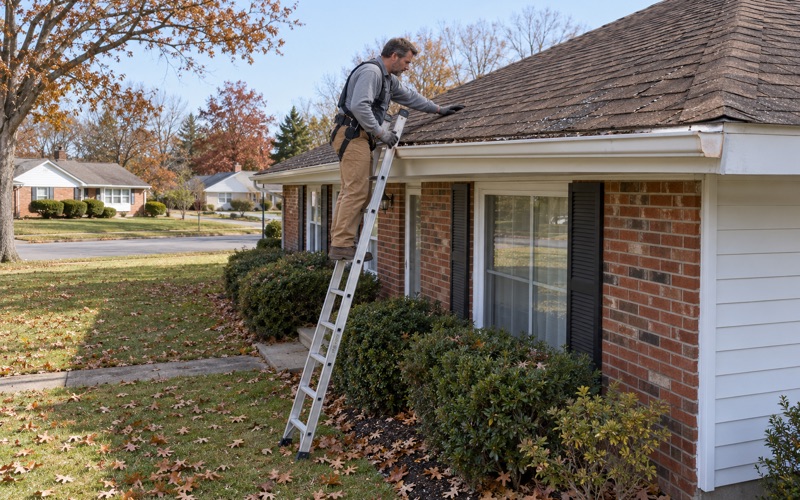
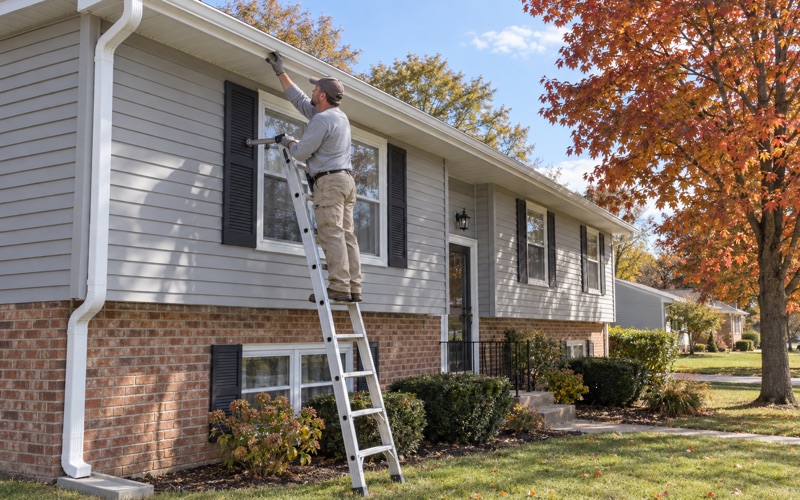
After a severe thunderstorm, the first check needs no ladder. Walk the property and look for shingle pieces, granules collected at the downspouts, and bent gutters or leaders. Note which side of the house faced the wind, because that is the slope to watch most closely. Binoculars from the far edge of the yard will show more of the ridge than standing at the foundation does.
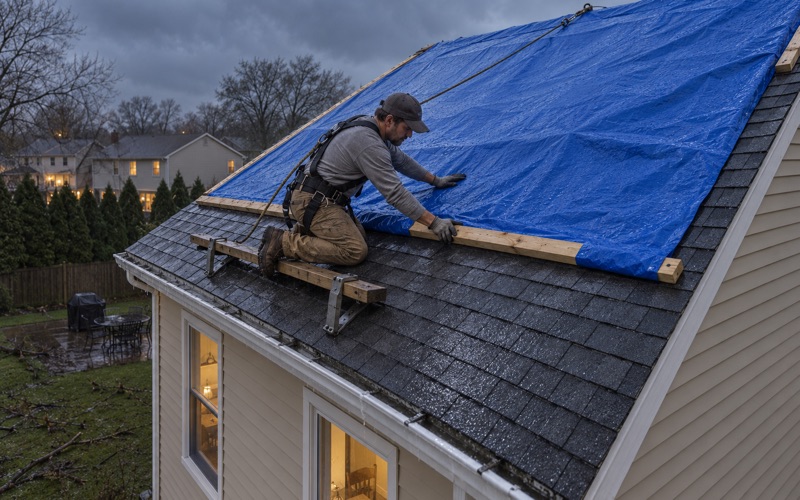
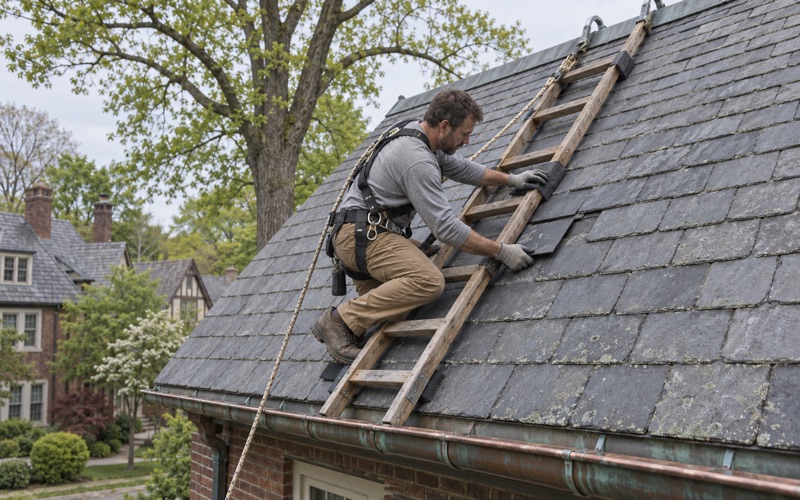
Please leave the climbing to a crew. A roof that looks dry can be slick with loose granules after a storm, and federal OSHA rules require employers to provide fall protection for residential roofing work at 6 feet. Owners do the most good by photographing what they can see safely and calling for a closer look.
What We Check Up Close
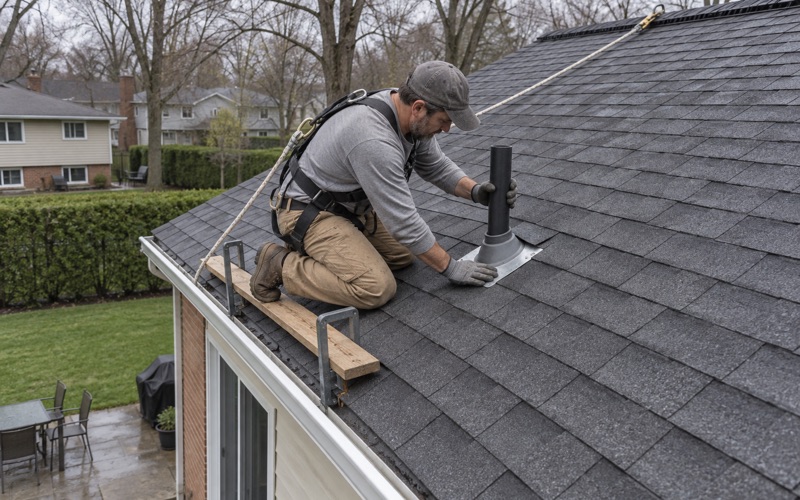
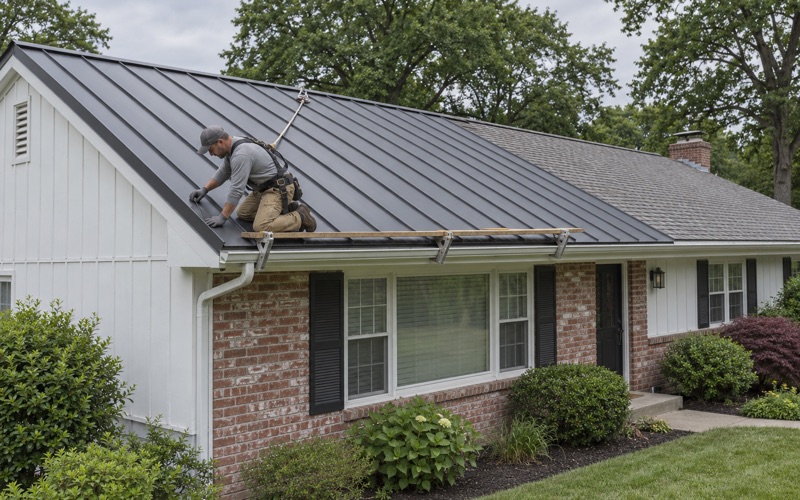
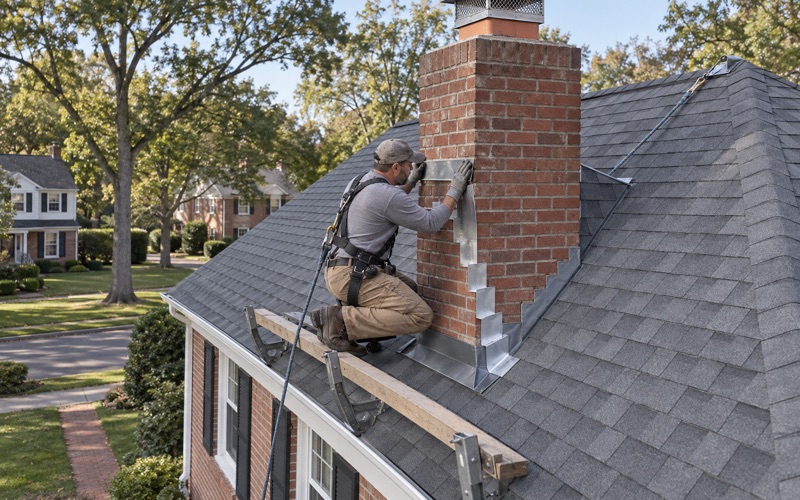
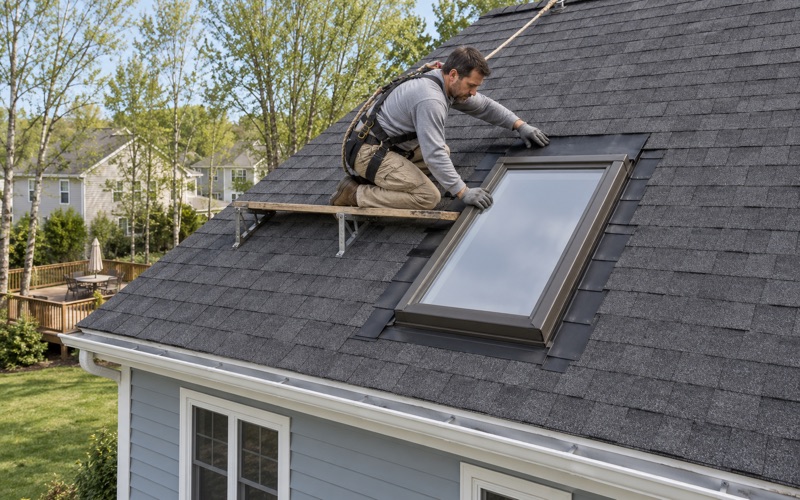
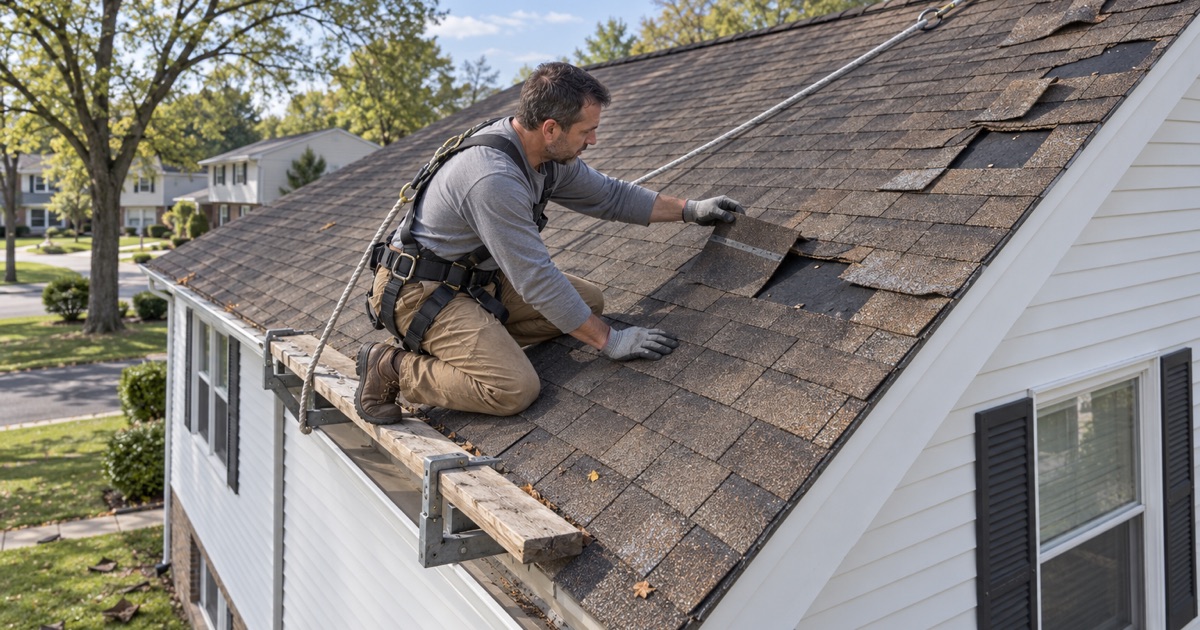
On the roof, we work the edges, the ridge and the windward slope first, lifting tabs gently to test whether the seal strip is still bonded. We check flashing at chimneys, walls and skylights, along with pipe boots, since wind can loosen any of them. Inside, the attic decking and insulation show whether water has already followed the damage in.
Storm findings get photographed and written up in a form you can use for your own claim. If you want us there when the insurance adjuster comes out, we will meet them on site and go over the damage together. The decisions on the claim stay with you and your insurer; our part is an accurate record of the roof.
Repair or Replace
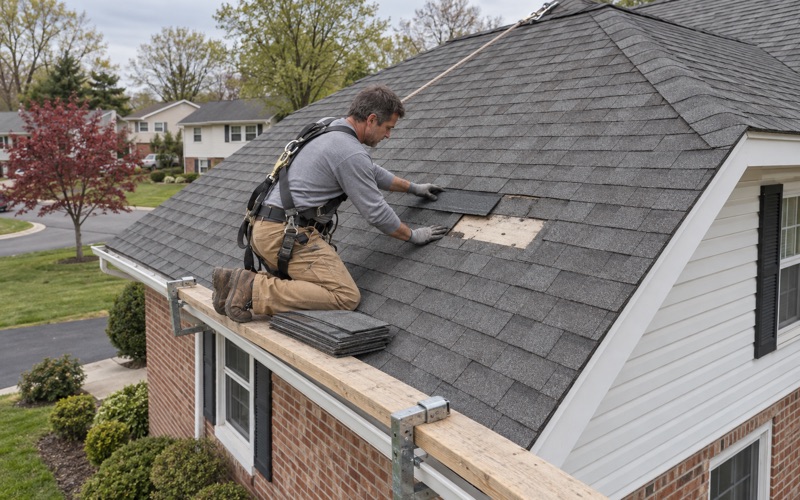
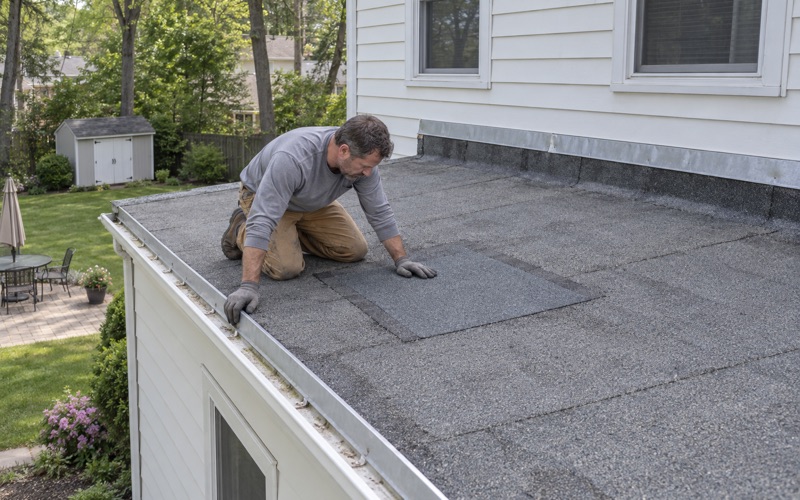
Many wind-lifted roofs can be handled with a targeted repair: resealing or replacing a run of edge shingles, resetting ridge caps and replacing bent drip edge. Each spot is photographed so you can see exactly what the repair covers. Where shingles are near the end of their life anyway, a repair may only buy a season, and we say so.
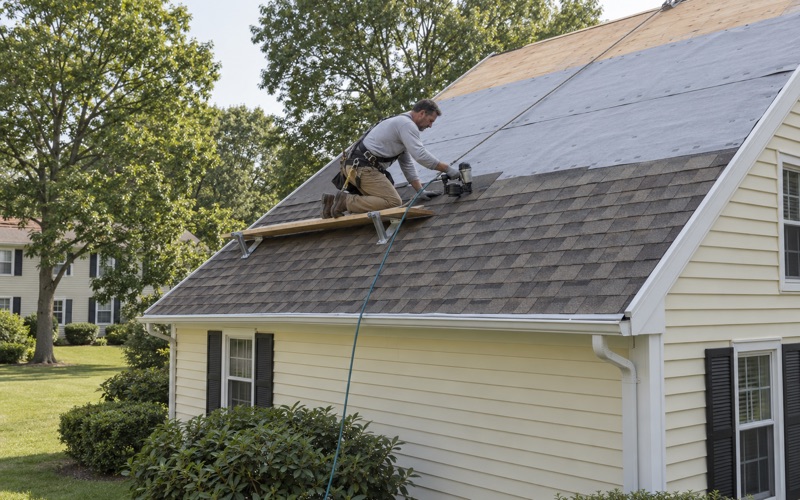
When a roof does need replacing, the scope covers what wind exposes: drip edge at eaves and rakes, a self-adhering ice and water barrier meeting ASTM D1970 along the edges, new step and counter flashing rather than caulk over the old, and a ridge vent balanced with soffit intake. Shingle color is picked against your own brick or siding, with samples held up at the house.
Any damaged decking found after tear-off is photographed and shown to you before it is replaced, at the per-sheet price already written into the contract. Nothing about the decking is a surprise on the invoice. At the end of each work day the yard, driveway and gutters are cleaned, magnet sweep included.
- 20+ Years on Local Roofs
- Repair-First Advice
- Itemized Written Scopes