Cherry Hill Roofing brings more than 20 years in the trade to roofing in Cinnaminson, and the question we hear most here is what the last storm did to a roof. A shingle roof rarely fails all at once. It loosens first along the eaves, the rakes and the ridge, and the early sign is usually a tab that has quietly lifted rather than a hole anyone can see from the driveway.
That is why our storm visits start at the roof edge and finish in the attic. Every leak call includes a look from underneath as well as from above, so we can trace water to the place it actually gets in before anyone puts a price on the fix. You also get a plain answer on whether the roof can be repaired before replacement ever comes up.
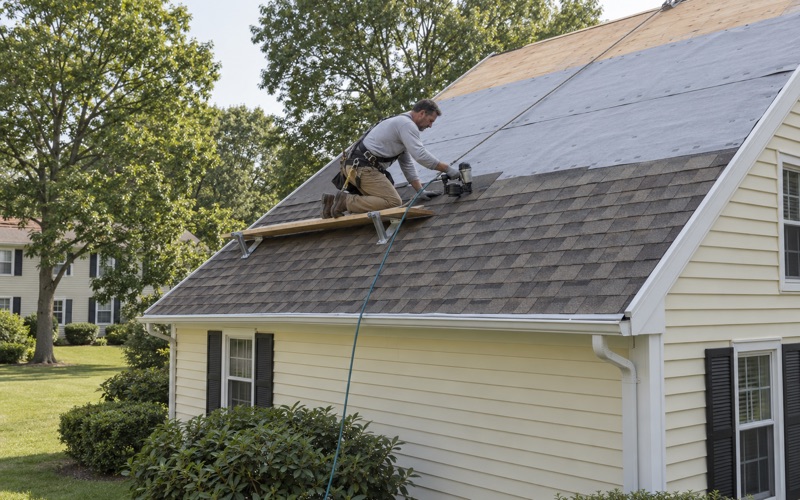
When a roof does need to come off, our written scope breaks the job into tear-off, decking, underlayment, flashing, ventilation and gutters as separate lines. That lets you set our number beside any other estimate and compare it item by item, which matters most when an insurance claim is paying for part of the work.
The April 2023 Tornado in Cinnaminson
Cinnaminson Township sits in Burlington County, was incorporated in 1860 and counted 17,064 residents in the 2020 census, with Route 130 running through it. It is a settled suburb rather than open country, so a tornado track here runs past houses, and the roofs along it carry the evidence.
Where It Touched Down
On Saturday, April 1, 2023, the National Weather Service confirmed an EF-1 tornado that touched down at about 6:59 p.m. near Riverton Road and Woodside Lane in Cinnaminson. It moved southeast for roughly six miles and ended in Moorestown a few minutes later, near the Laurel Creek Country Club neighborhood. The survey put its width at about 600 yards.
The estimated peak wind was 95 to 100 mph, and reporting on the survey gives slightly different figures, so we treat it as a range rather than one number. Coverage at the time described snapped trees, wrecked fences and downed power lines, with no injuries reported in Burlington County.
The House on Wynwood Drive
The strongest damage the survey found was near Wynwood Drive and Locust Lane. There, according to reporting on the National Weather Service findings, most of the roof covering was peeled off a single-family home. That one description is the clearest record of what this storm did to a roof in the township.
We are careful not to stretch it. No source we have counts damaged roofs across Cinnaminson, and we will not guess at one. What the Wynwood Drive house shows is the mechanism: wind at that strength got under the covering and kept pulling until most of it was gone.
Why a Local Record Matters
A storm that people remember tends to get blamed for everything, and one that missed a street gets forgotten. Knowing the actual track helps. A house near the path from Riverton Road toward Moorestown has a documented reason for a closer look, while a house well away from it still deserves one if shingles turned up in the yard.
It is also why we do not judge a roof from the street after a storm like that one. A covering that looks intact can still have unsealed tabs along its edges, and those are the ones the next strong gust finishes off. A short inspection settles the question either way.
Looking for roofing closer to Delran? See Roofing in Delran.
What 95 to 100 mph Wind Does to Post-War Roofs
The Wynwood Drive roof is an extreme case, but the same forces act on any shingle roof in a strong gust, only less dramatically. Understanding how a covering fails tells you where to look after an ordinary storm, not just after a tornado.
Edges and Ridge Go First
Wind does not push evenly on a roof. It speeds up as it crosses the eaves, rakes and ridge, and the suction there tries to lift the bottom of each shingle tab off the course below. Once a seal strip lets go, the tab acts like a small sail, and the next gust works it further.
That is the order in which a roof covering comes apart: edge shingles and ridge caps first, then the field, and only after that the underlayment and decking. By the time bare wood shows, the damage started much earlier at the perimeter, which is where we look before anything else.
Cinnaminson’s 1950s and 1960s Houses
Cinnaminson’s housing leans heavily toward one era. Census estimates count 3,150 of the township’s 6,320 housing units as built between 1950 and 1969, and 4,728 of them as detached houses. Most occupied homes are owner-occupied, so the decision about a storm-worn roof usually sits with the person living under it.
Houses from that period were not built with today’s roof edge details. A roof on a house of that age is unlikely to be its first, and a newer covering can sit over older decking and eave work that was never updated. On those houses we check whether drip edge is present at the eaves and rakes, because a bare edge gives wind an easier start.
Shingles Rated for Wind
When a storm-worn roof is replaced, the shingle matters. Architectural shingles such as GAF Timberline HDZ, Owens Corning Duration and CertainTeed Landmark carry wind ratings under standards such as ASTM D3161 Class F and ASTM D7158 Class H, and the rating holds only when the nailing and starter courses follow the maker’s instructions.
We also plan ventilation with the new covering, a ridge vent balanced by soffit intake, so the attic breathes the way the shingle maker expects. Where you want to see options, we hold shingle samples up against the brick or siding on your actual house before you choose a color.
Checking Your Roof After a Severe Storm
What You Can See From the Ground
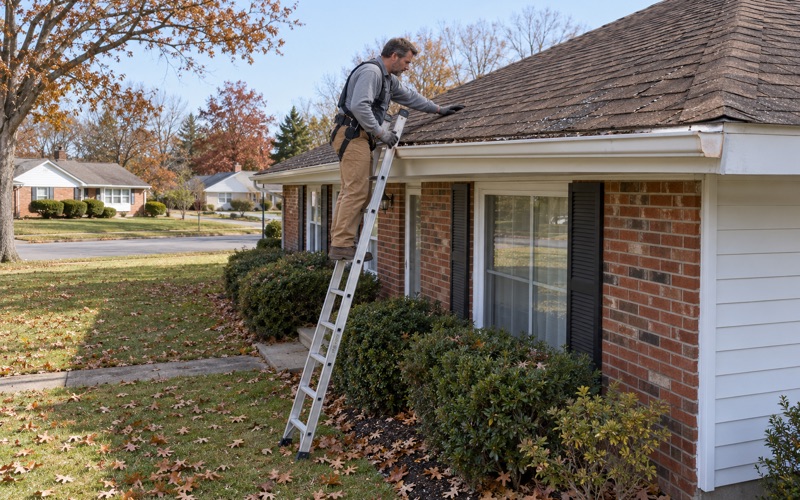
You do not need a ladder to start. Walk the yard and driveway for shingle pieces, ridge caps or torn strips of granule-covered material, and look at the roofline from across the street. A lifted tab often shows as a shadow line or a slightly raised edge at the eave or ridge.
Check gutters and downspouts too. A heavy wash of granules after a storm, or a gutter pulled away from the fascia, tells us where the wind was working hardest. Please stay off the roof itself; a wind-loosened surface is a poor place to stand, and the edge is exactly where it gives way.
What We Check on the Roof
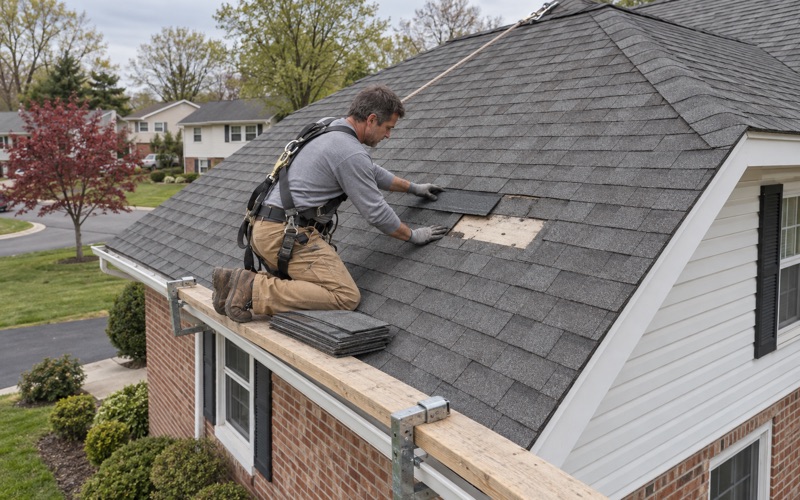
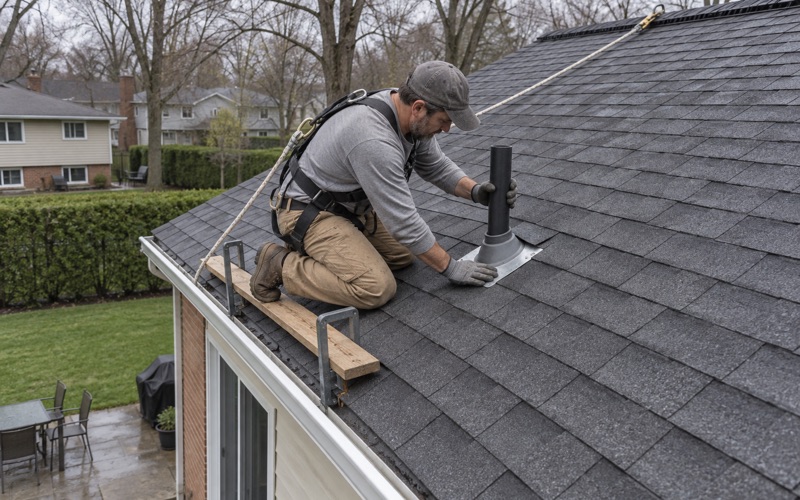
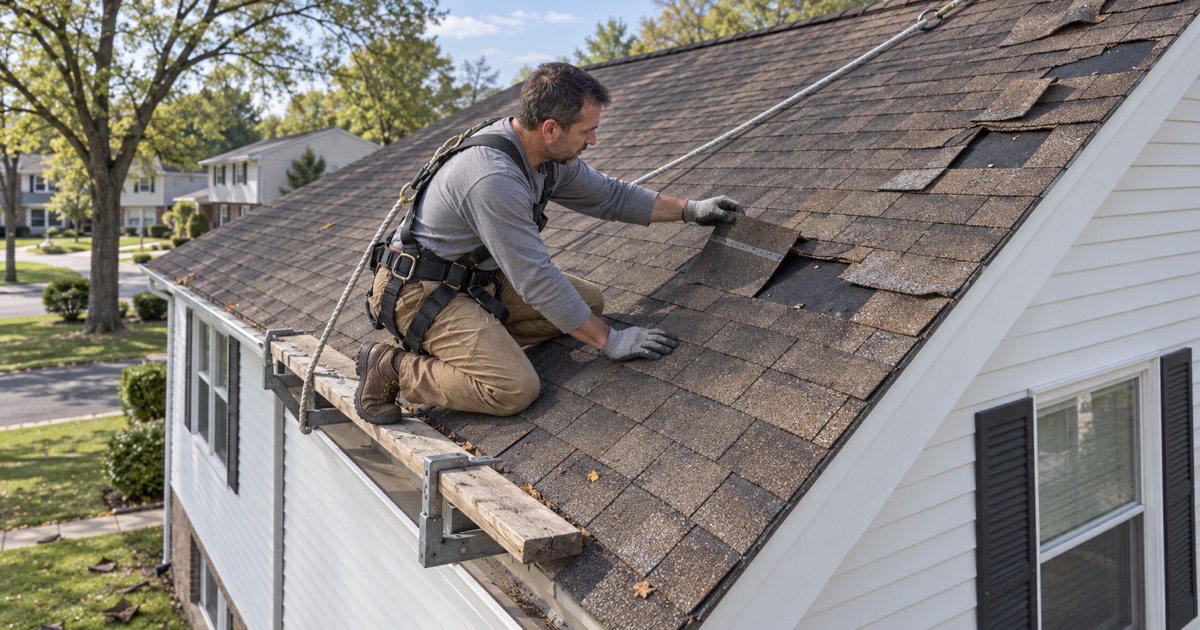
On the roof we lift-test tabs along the eaves, rakes and ridge to find seal strips that have let go, even where a shingle settled back flat. We look for creased tabs, missing ridge caps, pipe boots torn at the collar and flashing pulled away from chimneys and walls. Our crew works under fall protection, as OSHA requires for residential roofing at six feet.
Then we go into the attic. Daylight at the eaves, damp spots on the sheathing or fresh stains near a chimney show whether the storm opened a path for water, and they tell us where it actually enters rather than where it drips onto a ceiling.
Repair or Replace
Plenty of wind damage is repairable. A run of lifted edge shingles or a lost section of ridge cap can often be replaced and sealed, and if that is all the roof needs, that is all we quote. When most of the covering has let go, or the remaining shingles have aged past resealing, a new roof is the honest answer.
If the old roof comes off, any damaged decking we find is photographed and shown to you before it is replaced, at the per-sheet price already written into the contract. Flashing at chimneys and walls is replaced rather than caulked over, and the yard and driveway get a magnet sweep for nails at the end of each day.
Storm Damage, Insurance and the Adjuster
A wind claim on a roof is decided largely on evidence, and evidence fades. Shingles get raked up, gutters get cleared and a lifted tab can settle back down, so the sooner a roof is looked at after a storm, the more there is to show.
Documenting the Damage
If you plan to file a claim, clear photographs help. We photograph the storm damage, from lifted eave shingles to torn ridge caps and any marks in the attic, and write it up for your own claim. The report describes what we found and where, so the adjuster is looking at the same roof we did.
Write down when the storm came through and when you first noticed damage, since a claim ties the roof to a specific event. A warning issued by the National Weather Service office in Mount Holly for the Northwestern Burlington forecast zone, which covers Cinnaminson, gives you a dated reference to keep with your photos.
Meeting the Adjuster
When you ask, our crew will meet the insurance adjuster at the house and walk the roof with them. We point out the lifted edges, the ridge and any attic evidence, and the adjuster makes the coverage call. We are there to show the damage clearly, not to negotiate your claim.
That line matters in New Jersey. Negotiating a claim on a homeowner’s behalf is the work of a public adjuster, licensed under the state’s Public Adjusters’ Licensing Act, and a roofer is not one. New Jersey also sets claim settlement deadlines for insurers under N.J.A.C. 11:2-17, and knowing that helps you follow where your claim stands.
Your Contract and Timing
Once a claim is settled and you decide to go ahead, our contract follows New Jersey’s home improvement rules, cancellation notice included. The scope is itemized the same way as any estimate we write, which makes it straightforward to hold against the adjuster’s line items.
If solar panels sit on the roof, their removal and reinstall go into the schedule from the start rather than turning up on the day. A replacement that counts as a capital improvement may also call for a Form ST-8 certificate, which we can talk through with you before the job begins.
- 20+ Years on Local Roofs
- Repair-First Advice
- Itemized Written Scopes