Cherry Hill Roofing brings more than 20 years in the trade to roofing in Burlington, and this page is about one specific planning problem: what happens when a new roof is only one part of a larger renovation. On some properties the roof’s cost matters to more than the household budget, because federal flood rules may count it. We would rather say so at the estimate than after the contract is signed.
Most re-roofs are simple decisions about material, color and timing. A house that may sit in a mapped flood hazard area is different, because the total cost of improvements can trigger requirements that have nothing to do with shingles. We do not make that call, and we will not guess at it. What we can do is hand the owner a written scope clean enough that whoever reviews the project can see exactly what the roof adds.
Everything else on the job stays the same. We trace leaks from the attic before we price anything, and we tell you plainly whether a repair will do before replacement comes up. The sections below walk through the flood side of the work, which is the part of a Burlington job that needs the most planning.
Burlington on the Delaware and its 2017 flood map
A long record on the river
Burlington City has been a participant in the National Flood Insurance Program since its first flood insurance rate map took effect on July 23, 1971. The map in force today became effective on December 21, 2017, and it is the reference any floodplain question on a city property starts from. Whether a particular lot falls inside the special flood hazard area is a question for that map, not for a roofer’s guess.
The city’s riverfront runs from the Burlington-Bristol Bridge, opened in 1931, to Assiscunk Creek. Flood-control and urban-renewal projects in the late 1960s and 1970s reduced flood risk to riverfront businesses. Those projects changed the ground the old stories come from, which is one reason we point owners to the current map rather than to memory of past high water.
What CRS class 7 means for a homeowner
Burlington joined FEMA’s Community Rating System on April 1, 1998, and has held class 7 since October 1, 2018. The program rewards communities for floodplain management that goes beyond the minimum, and class 7 carries a 15 percent discount on flood insurance premiums for policies in the special flood hazard area. It is a community-wide rating, earned by the city rather than by any one house.
For a homeowner, the rating is a reason to keep the city’s floodplain rules in view, not a promise about any one bill. We cannot tell you what your premium will be, and we never quote flood-insurance savings as part of a roofing estimate. What we can do is keep the roof work from creating a surprise in the owner’s floodplain paperwork later.
Reading the map before the estimate
When an owner tells us a re-roof is part of a bigger plan, such as a kitchen, an addition or new windows, our first question is whether anyone has checked the property against the 2017 map. If the answer is no, we suggest doing that before any numbers are final. Asking early changes how the estimate should be written.
A lot outside the special flood hazard area simply gets an ordinary roofing scope. A lot inside it gets the same scope, written so the roof’s share of a combined project can be lifted out and added to everything else without anyone having to reconstruct it from a lump sum.
Looking for roofing closer to Waterford? See Roofing in Waterford.
The 50 percent substantial-improvement test
How the test works
Under the federal flood rules, a building in the special flood hazard area whose improvement cost reaches 50 percent of its market value counts as a substantial improvement. Once a project crosses that line, the building must be brought into compliance with the floodplain requirements rather than simply repaired or updated. That can change the scale of a renovation far more than any single trade’s line item.
The test compares cost to value, so the same project can land on either side of it depending on the house. A modest set of improvements on a high-value property may stay well under, while the same work on a smaller, older building may not. That is why we treat every component as something that might be added up.
What FEMA counts and what it leaves out
FEMA’s guidance on the rule, FEMA P-758, comes with a list of costs to include, and floodplain offices restate it for owners. Roofing appears on it twice: ‘re-shingling or retiling a roof’ and ‘wood or reinforced concrete decking or roofing.’ Overhead, profit and the labor to demolish or remove components are counted as well.
Some costs stay off the tally. Plans, surveys, permit fees, debris removal and cleanup, outside improvements and detached structures are excluded. For a roofing scope, that means the dumpster and haul-away line should be separated from the tear-off labor, because one is counted and the other is not.
Where the local rule takes over
The federal test sets the floor, and each community writes its own floodplain ordinance on top of it. Some count improvements over a period of years, and some set their own threshold. We have not built Burlington’s ordinance into our estimates, so we do not tell owners how the city adds up past work or who signs off on the result.
That question is worth asking the city before the work is scheduled. We will put the roof portion of a project in writing for that conversation, broken out so it can be checked line by line, and we will wait on the owner’s answer before the tear-off date is set.
Why a re-roof belongs in the tally
On its own, or as part of a renovation
We have no basis to say that a roof by itself crosses the 50 percent line, and we never tell owners it does. The concern is the combined project, where the roof sits beside a kitchen, new mechanicals or an addition and the counted lines add toward one total. Leaving the roof out of that arithmetic because it seems like routine upkeep is the mistake we try to head off.
When an owner is planning interior work and a roof in the same project, we ask to see the whole plan rather than the roof alone. We are not adding up anyone’s renovation, but knowing what else is in the project tells us how much detail the roof scope needs to carry. A roof quoted as one number is hard to place in someone else’s arithmetic.
Decking, tear-off and the lines that count
Our written scopes already list tear-off, decking, underlayment, flashing, ventilation and gutters as separate lines, which is how two estimates can be compared item by item. On a floodplain project that same habit does a second job. Decking appears on FEMA’s include list by name, so a clear decking line is worth having before anyone starts adding.
Decking is also the one cost no one can see until the old roof is off. When we find damaged sheets, we photograph them and show the owner before replacing anything, at the per-sheet price written into the contract. That keeps the final roofing figure traceable rather than a number that grew without explanation.
Flashing and materials, priced on their own
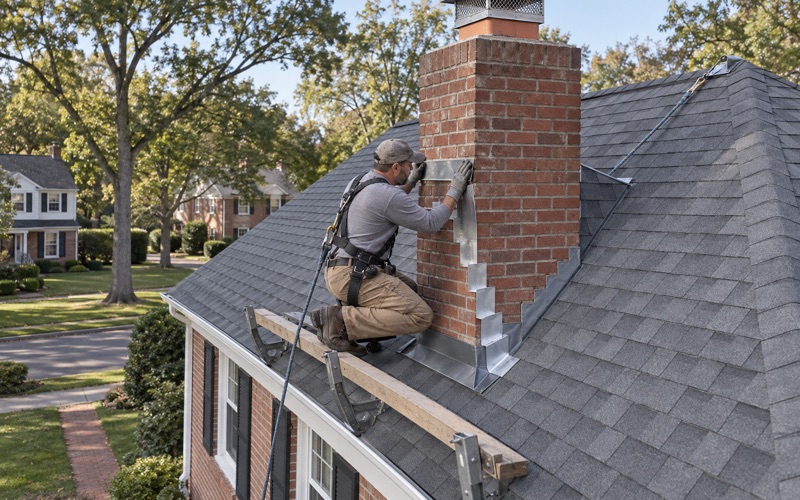
When we redo a roof, flashing at chimneys, walls, skylights and valleys where two roofs meet is replaced rather than caulked over. That is a deliberate cost, and on a combined project it should show up as its own line rather than hide inside a shingle price. The same goes for new step flashing, counter flashing and drip edge at eaves and rakes.
Material choice changes the number too. Architectural shingles such as GAF Timberline HDZ or CertainTeed Landmark, standing seam metal and natural slate land at very different costs, and an owner weighing a combined project deserves to see each option priced cleanly before choosing. We give that comparison in writing.
Planning roof work on a riverfront house
Older houses and matching material
Burlington was settled by English Quakers in 1677, and its housing shows the age. Of the city’s 4,208 housing units in the latest five-year Census estimates, 1,720 were built in 1939 or earlier. On a house that old, we expect to find earlier repairs and mixed materials, and we say so in the estimate instead of discovering it on the day.
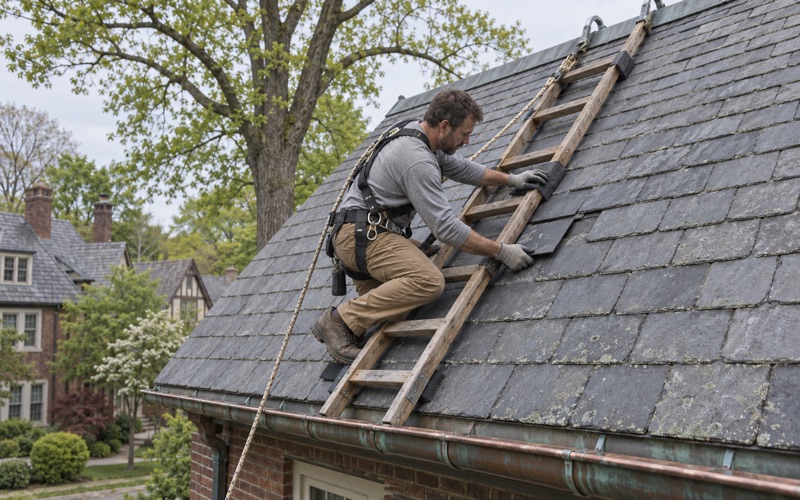
Where a slate or older roof can be repaired, we repair it with matching material when it can be sourced rather than whatever is on the truck. On properties in the High Street and Burlington City historic districts, the city’s Historic Preservation Commission reviews exterior changes, and we build that review into the schedule rather than work around it.
Sequencing the roof with the rest of the project
On a riverfront renovation, the order of work matters. We prefer to know where the project stands on the floodplain question before ordering material, so a roof is not installed on a house whose plans may still change. If solar panels are coming off and going back on, that removal and reinstall goes into the schedule from the start.
Our contracts follow New Jersey’s home improvement rules, including the cancellation notice. Shingle color is picked on site against the brick, stone or siding of the actual house, with samples held up where the owner can see them in daylight. Neither step changes for a floodplain project, but both matter more when a roof is one of several decisions being made at once.
Storms, claims and the work day
Burlington sits in the National Weather Service’s Northwestern Burlington forecast zone, covered by the Mount Holly office, and that is where we watch the forecast before a tear-off. When storm damage is behind the call, we photograph it and write it up for the owner’s own claim, and we will meet the insurance adjuster on site when asked.
At the end of each work day, the yard, driveway and gutters are cleaned and the ground gets a magnet sweep for roofing nails. On a job that may run alongside other trades, that daily reset keeps the site clear for everyone arriving the next morning.
- 20+ Years on Local Roofs
- Repair-First Advice
- Itemized Written Scopes