Cherry Hill Roofing has spent more than 20 years on roofing in Bellmawr and the rest of this part of Camden County, and the first thing we settle on any job here is a simple question: whose roof is it, and who gets to decide what happens to it? In most towns that answers itself. In this borough it does not always, and getting it right before anyone climbs a ladder saves everyone a wasted estimate.
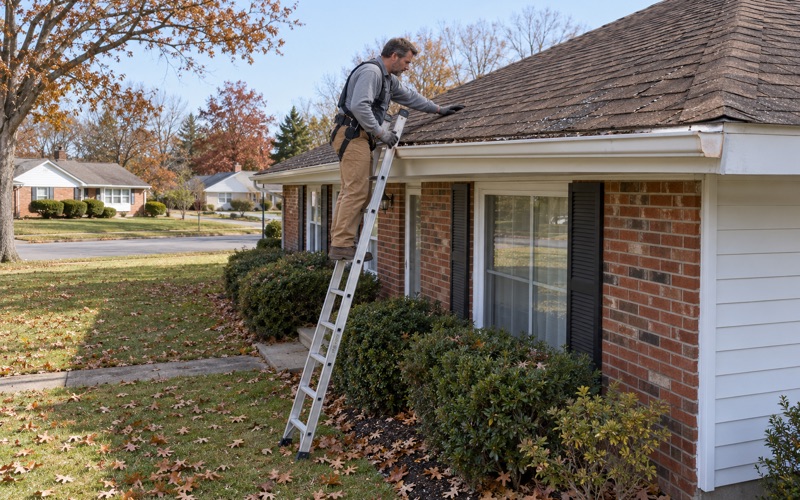
When a homeowner calls about a leak, we look in the attic as well as on the roof, so we find where the water actually gets in before we put a price on anything. We tell you plainly whether the roof can be repaired, and only after that do we talk about replacement, if it is truly needed.
Our written scopes break out tear-off, decking, underlayment, flashing, ventilation and gutters line by line, so you can set our number beside anyone else’s and compare item for item. That holds whether you own a detached house outright, share a roof line with a neighbor, or live in a home owned by a housing corporation.
Bellmawr Park and Its Mutual Housing Roots
A Federal Defense Housing Project
Bellmawr Park is not an ordinary subdivision. Its 500 homes were built at the start of the 1940s by the Federal Works Agency’s Mutual Ownership Defense Housing Division, which put up housing for the families of moderate-income defense workers. The division’s projects went up between autumn 1940 and winter 1942, and sources disagree on the exact year for this one, so we do not treat any single date as settled.
The architects were Mayer & Whittlesey with Joseph N. Hettel, and the development cost was recorded at $2,321,000. For a roofer, the useful takeaway is that these homes were designed and built as one planned group rather than lot by lot. Whoever looks after them is looking after a set of buildings, not a single house.
Bought From the Government in 1953
In 1953 the homes were purchased from the government by a residents’ housing corporation. Records list Bellmawr Park as owned and maintained by the Bellmawr Park Mutual Housing Corporation, and a 2016 newspaper account described the corporation as a private property management firm.
That mutual housing arrangement is what sets Bellmawr Park apart from the rest of the borough. The buildings sit under one owner rather than hundreds of separate deeds, and that changes who a roofer should be talking to before any work is discussed.
Looking for roofing closer to Gloucester City? See Roofing Services in Gloucester City.
When a Housing Corporation Owns the Roof
Who Makes the Call
Because the corporation is recorded as owning and maintaining the homes, a roof in Bellmawr Park is a decision for the Bellmawr Park Mutual Housing Corporation, not for one household acting alone. We have not read the corporation’s own documents, so we cannot tell you its rules, its schedule or how it handles a roof request. What we can say is that the corporation is the place to start.
If you live in Bellmawr Park and notice a ceiling stain or shingle pieces in the yard after a storm, report it to the corporation first. If it then wants an outside assessment, we are glad to provide one on the same terms as any other job. We have no relationship with the corporation and do not speak for it.
What We Can Offer a Resident or Manager
A leak inspection is useful no matter who ends up paying for the repair. We check the attic as well as the roof surface, photograph what we find, and write it up plainly, so whoever decides has a clear record of where the water enters and what it would take to stop it.
Our itemized scopes help here too. When each part of the job sits on its own line, a manager weighing several bids across a group of homes can see exactly where two numbers differ, rather than comparing one lump sum against another.
Storm Damage on a Shared Building
After wind or hail, we photograph the damage and write it up for the owner’s own claim, and we will meet the insurance adjuster on site when asked. Where the owner of record is a corporation rather than an individual, the paperwork goes to whoever holds the policy.
That distinction is easy to miss after a storm, when a resident is understandably the first person to call. We will still come out and document what we see, but we will be clear about who the report belongs to and who can approve the repair.
Bellmawr’s Postwar Detached Houses
A Town That Grew Fast in the 1950s
Outside Bellmawr Park, most of the borough is detached houses whose owners make their own roofing decisions. Bellmawr grew from 1,250 people in 1940 to 5,213 in 1950 and 11,853 in 1960, and the housing stock still shows it. Census estimates put 2,933 of the borough’s 5,016 homes in the 1950-1969 window, with 1,431 from the 1950s alone and 1,502 from the 1960s.
That means a large share of local roofs sit on houses roughly six to seven decades old. On houses that age, the roof covering has usually been replaced at least once, and the decking beneath it may be the oldest material left on the roof.
What a Tear-Off Can Reveal
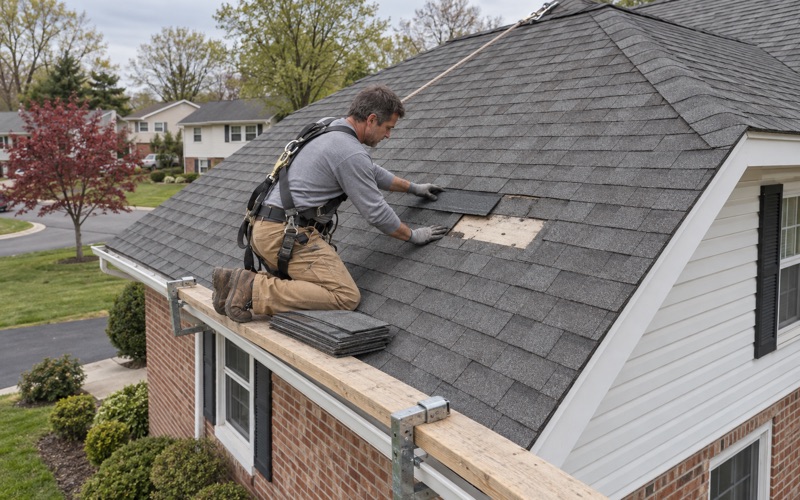
When an older roof comes off, the boards or sheathing underneath sometimes need attention. If we find damaged decking, we photograph it and show it to you before replacing anything, and the per-sheet price is already set in the contract, so the final bill holds no surprise.
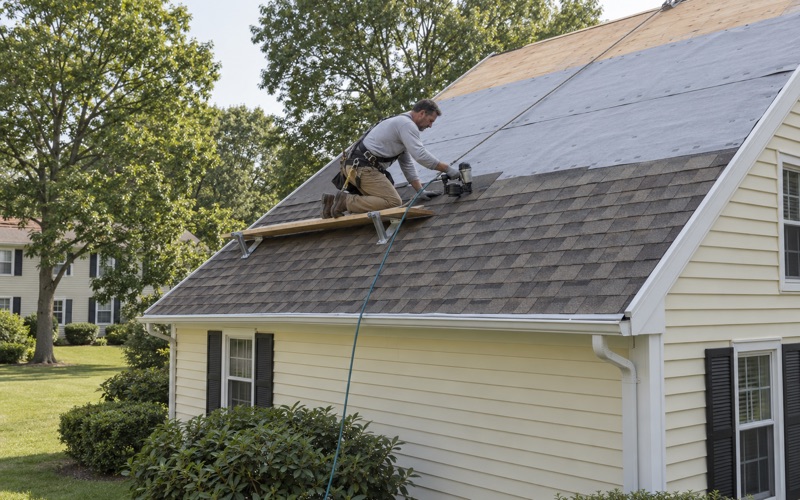
New roofs go down over ASTM D1970 self-adhering ice and water barrier at the eaves and in valleys, with synthetic underlayment meeting ASTM D8257 across the field. Drip edge goes on at the eaves and rakes so water clears the fascia instead of wicking back behind it.
Ventilation in Mid-Century Attics
Attics on houses of this age often were not built with the airflow a modern shingle roof expects. We check soffit intake against ridge exhaust and size a ridge vent by net free area, because a roof that cannot breathe ages its shingles and decking from underneath.
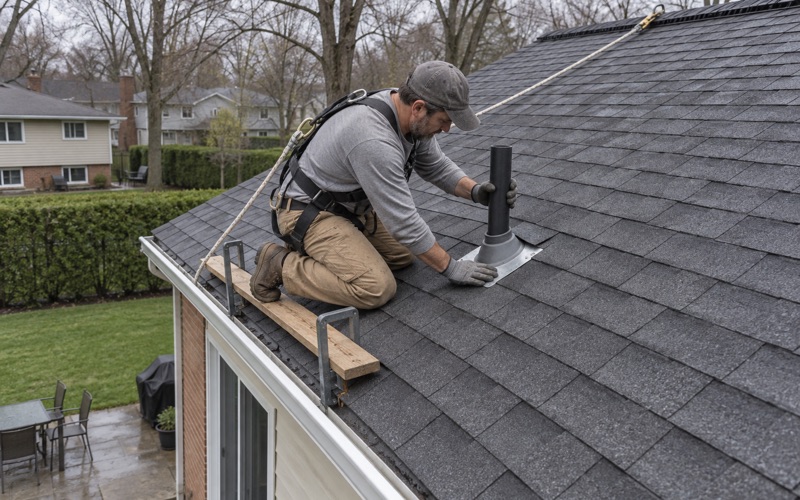
Pipe boots get the same attention. A cracked rubber collar around a plumbing vent is one of the most common sources of a slow leak on an older detached house, and it is usually a repair, not a reason for a new roof.
Choosing Shingles Against Brick and Siding
Architectural shingles such as GAF Timberline HDZ, Owens Corning Duration and CertainTeed Landmark are the usual choice for a detached house here. We pick a color by holding samples against the brick, stone or siding on your actual house, rather than choosing from a small chip under office lights.
Ratings matter as much as color. We point out which product lines carry ASTM D3161 Class F or ASTM D7158 Class H wind ratings and an ASTM E108 Class A fire rating, so comparing shingles is about more than how they look from the street.
The Older Houses Before the Boom
Not every house in Bellmawr is postwar. Census estimates count 768 homes from the 1940s and 406 built in 1939 or earlier, from the years when the borough, incorporated in 1926 and named for farm owner Ernest C. Bell, was still a small place.
On an older roof, we repair with matching material where it can be sourced rather than patching with whatever happens to be on the truck. If the original covering cannot be matched, we say so and walk through the options before any work starts.
Attached Homes, Shared Roof Lines and Planning Ahead
Where Two Roofs Meet
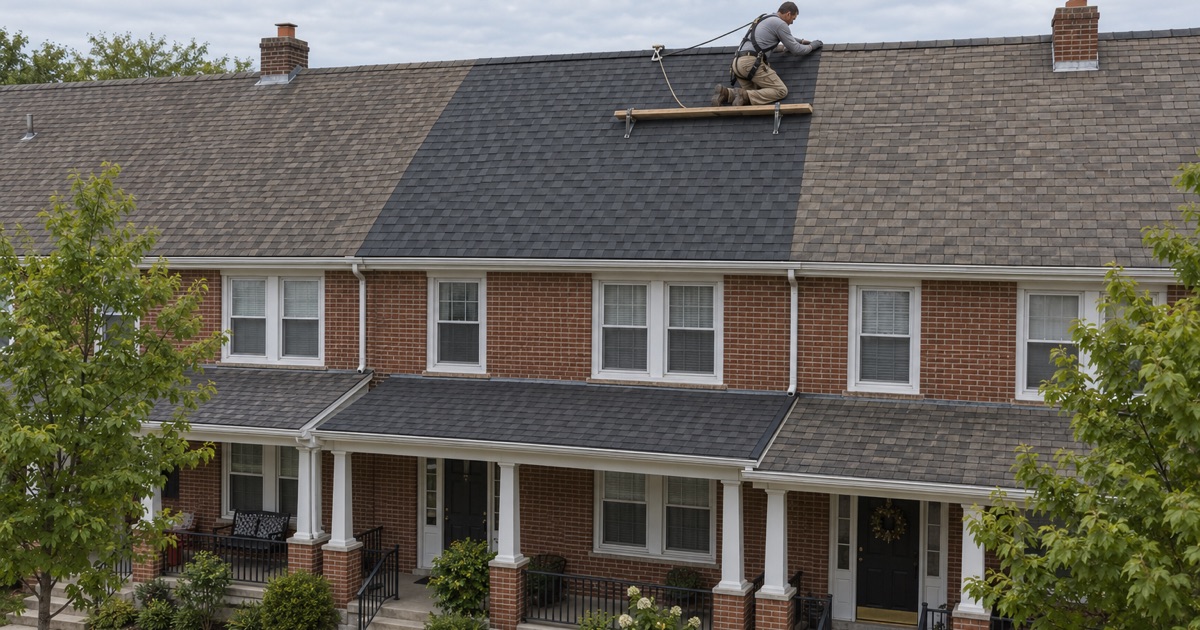
Bellmawr has 859 one-unit attached houses, about 17 percent of its housing. On an attached home, one roof often runs across two or more households, and the joint between sections is where water tends to find its way in.
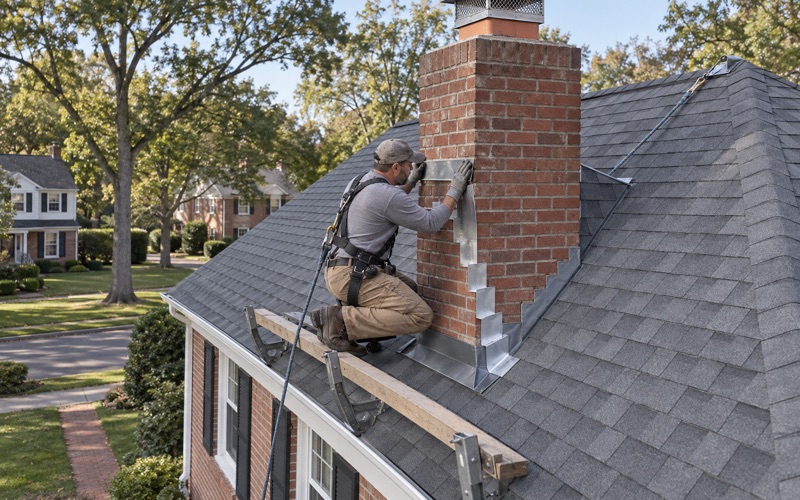
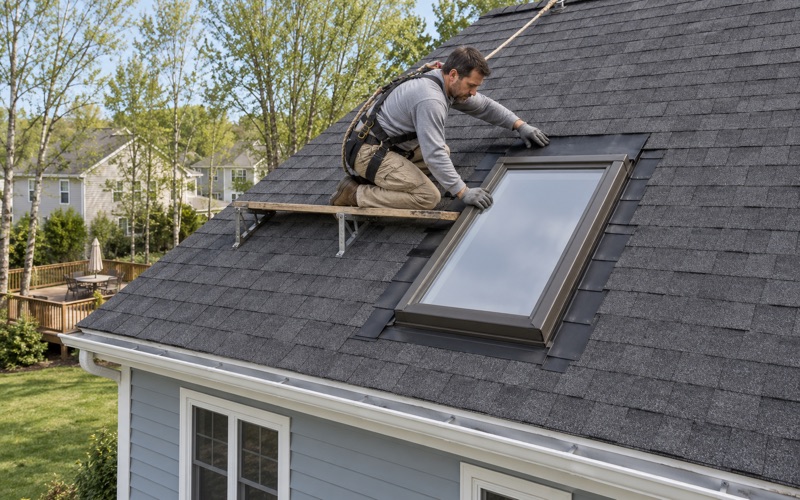
When we redo a roof, flashing at walls, chimneys, skylights and the line where two roofs meet is replaced rather than caulked over. On a shared roof line, the plan also has to account for the neighbor’s section, so the seam stays watertight after our crew leaves.
Step Flashing, Counter Flashing and Crickets
Where an attached roof meets a taller wall, we use step flashing woven under each shingle course and counter flashing set into a reglet, so the wall and the roof can move without opening a gap. A wide chimney gets a cricket, or saddle, on its uphill side to split the water around it.
Where a roof edge ends against a wall, a kick-out flashing turns water into the gutter instead of down the siding. These are small parts, but on a building with several roof sections they are where leaks commonly start.
Owners, Tenants and the Adjoining Home
Most of the borough’s attached units are rented: 620 of them, against 214 that are owner-occupied. A tenant who spots a leak should go to the owner or manager, and an owner planning work on a shared roof will want the adjoining owner informed before the tear-off starts.
We are happy to look at both sides of the joint and explain what it needs. A seam that is sound on one side and failing on the other is common, and a written note both owners can read keeps the conversation simple.
Solar, Contracts and Daily Cleanup
If your roof carries solar panels, we build their removal and reinstall into the schedule from the first estimate rather than discovering them on the day. Our contracts follow New Jersey’s home improvement rules, including the cancellation notice.
At the end of every work day, the crew cleans the yard, driveway and gutters and runs a magnet sweep for nails. On a tight lot beside a neighbor’s driveway, that daily cleanup matters as much as the roof itself.
Watching the Forecast Before We Open a Roof
Bellmawr sits in the National Weather Service’s Camden forecast zone, served by the Mount Holly office, and we check that forecast before any tear-off. If rain is coming, we open only as much roof as we can dry in the same day.
Whether the house is detached, attached or part of Bellmawr Park, the work ends the same way: a written scope, a straight answer on repair versus replacement, and a roof closed up every night. A first visit from us is an inspection and an honest read of what the roof needs, nothing more.
- 20+ Years on Local Roofs
- Repair-First Advice
- Itemized Written Scopes